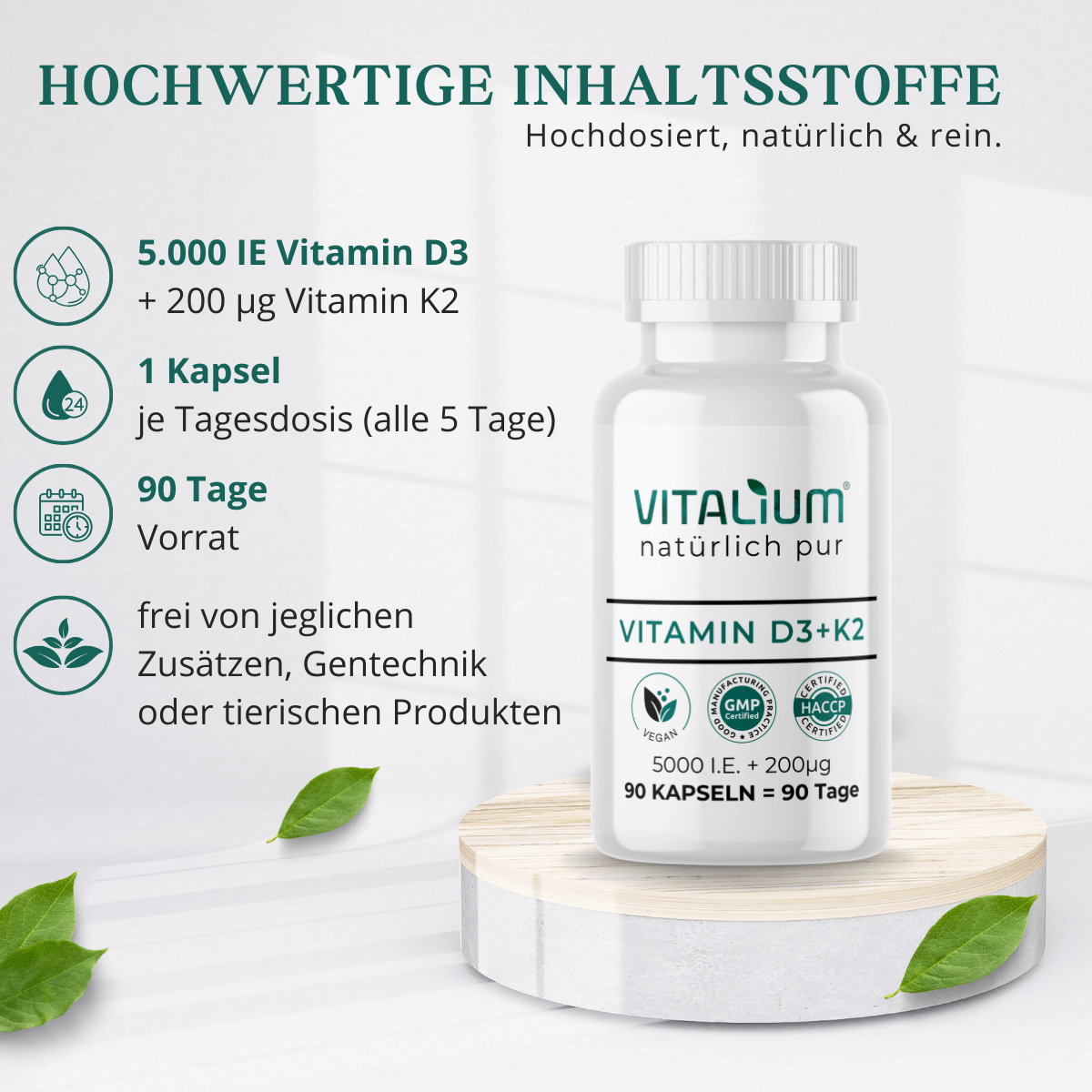
One capsule on the day of intake
Take one capsule whole with plenty of water. Take the next capsule five days later.



Pay securely and easily with:


Your payment information is processed securely. We do not store credit card details nor have access to your credit card information.
Dosage
Take one capsule every 5th day, whole, with plenty of water, shortly before a meal.

1 capsule
every 5 days
This corresponds, on average, to 25 µg of vitamin D3 (1,000 IU) and 40 µg of vitamin K2 per day. On the day you take the supplement, you will consume 125 µg of vitamin D3 and 200 µg of vitamin K2.
One capsule on the day of intake
Take one capsule whole with plenty of water. Take the next capsule five days later.
Just before a meal
That is what the recommended intake says. Vitamin D and vitamin K are fat-soluble vitamins, so a meal with a little fat goes well with it.
Make a note of the days to take the supplement
Set a recurring reminder every five days or make a note of the next date after each dose.
Do not exceed the stated recommended dose. Food supplements should not be used as a substitute for a varied and balanced diet and a healthy lifestyle. If you are taking anticoagulant medication, only take this product after consulting your doctor. Keep out of the reach of young children.
Your routine
One capsule each on days 1, 6 and 11; do not take any in between.
Mathematically, this amounts to an average of 25 µg of vitamin D3 and 40 µg of vitamin K2 per day.

The ‘sunshine vitamin’
Vitamin D occupies a special position: the body can produce it itself with the help of sunlight. Without this endogenous production, the reference value set by the German Nutrition Society (DGE) is 20 µg per day.
The sun as the main source
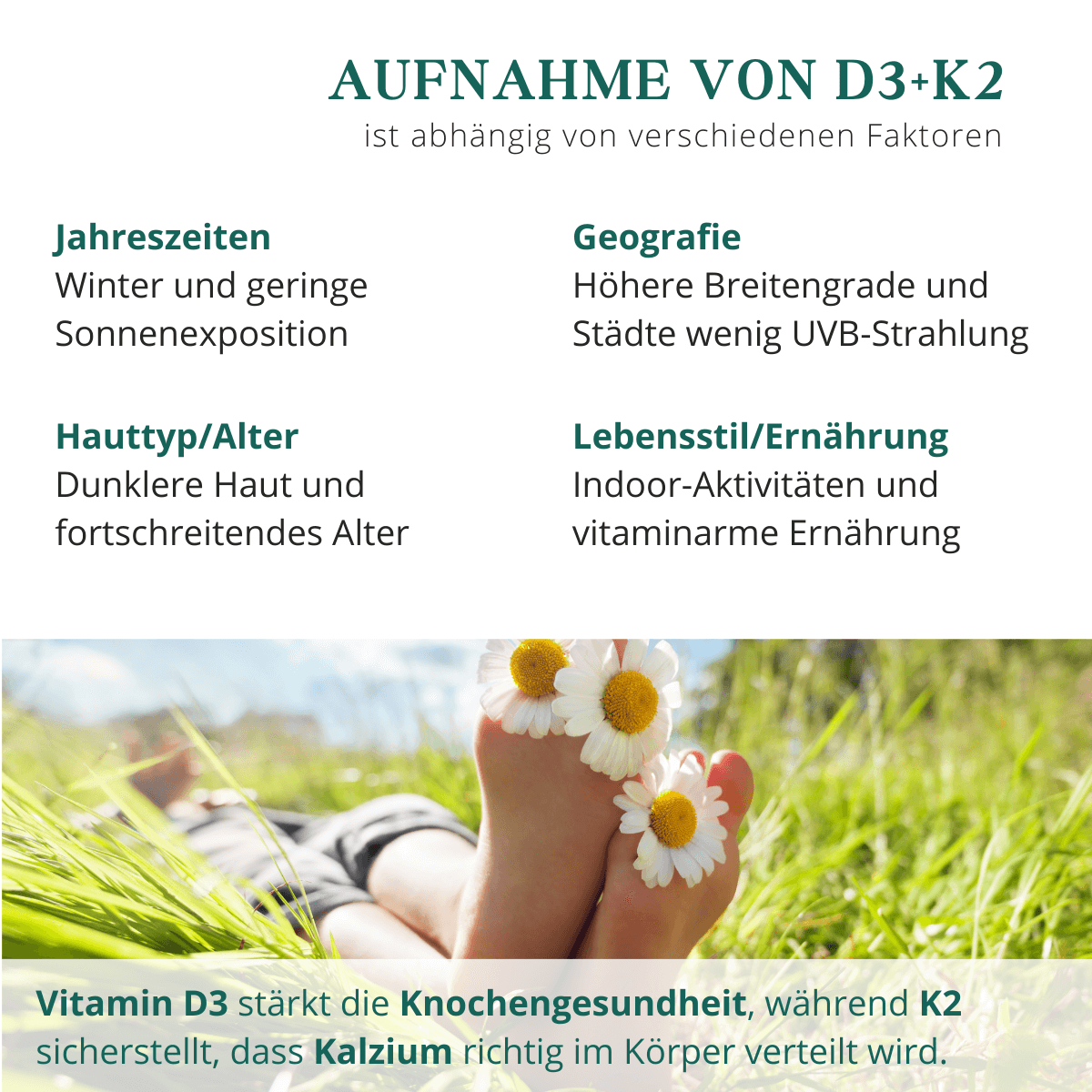
When spending time outdoors regularly, the skin produces around 80 to 90% of vitamin D with the help of UVB light. Diet usually contributes only 2 to 4 µg per day.
During the winter months, the sun is usually not enough
During the winter months, solar radiation in Germany is usually insufficient for adequate vitamin D production. Even those who work indoors a lot or always cover up in summer produce very little.
More than half do not reach the target level
In the Robert Koch Institute’s DEGS1 health study (2008 to 2011), after standardised analysis around 56% of adults were below the desirable blood concentration of 50 nmol/l, and around 15% even below 30 nmol/l.
Sun calendar
Simplified overview based on the DGE, BfR and MRI. During the winter months, solar radiation in Germany is usually insufficient for adequate vitamin D production. During the summer months, production depends, amongst other things, on skin type, time of day and time spent outdoors. Don’t live in Germany? As a rule of thumb: from a UV index of around 3, the skin can produce vitamin D. You can find the UV index for your location, for example, on the TEMIS UV Service (English).

Dosage explained
As well as the amount per capsule, we state the average daily intake. This allows you to easily compare the figures with the official recommendations.
What’s in a capsule
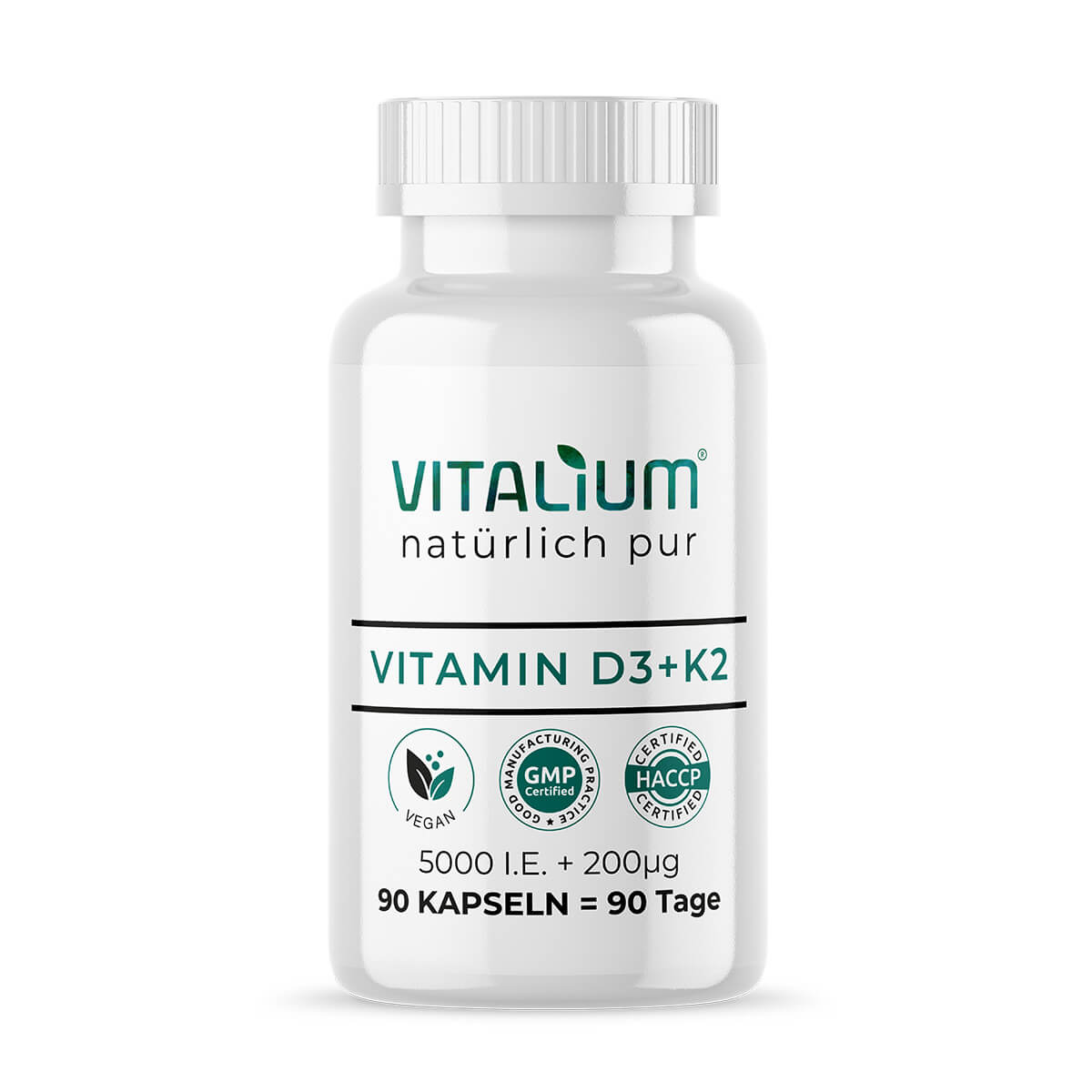
125 µg of vitamin D3 (5,000 IU) and 200 µg of vitamin K2. Mathematically, taking one capsule every five days works out at an average of 25 µg of vitamin D3 and 40 µg of vitamin K2 per day. On the day you take the capsule, you consume the full amount.
Good to know
The German Federal Institute for Risk Assessment (BfR) recommends a maximum of 20 µg of vitamin D and 25 µg of vitamin K2 per daily dose for food supplements and favours low-dose preparations taken daily. In mathematical terms, our capsules exceed this average daily amount. A harmonised EU upper limit for vitamins D and K in food supplements has not yet been established. It is best to check with your doctor whether this dosage is suitable for you.
Do not double up
Add up all sources, including multivitamin supplements and fortified foods. The European Food Safety Authority (EFSA) specifies 100 µg of vitamin D per day as the tolerable upper limit for adults when consumed over the long term from food and supplements. If you wish to combine several vitamin D supplements, it is best to discuss this with your doctor.
Comparison
Daily values in micrograms (µg); 1 µg is equivalent to 40 IU. The daily average is a calculated value and is not the same as daily intake.
Raw materials
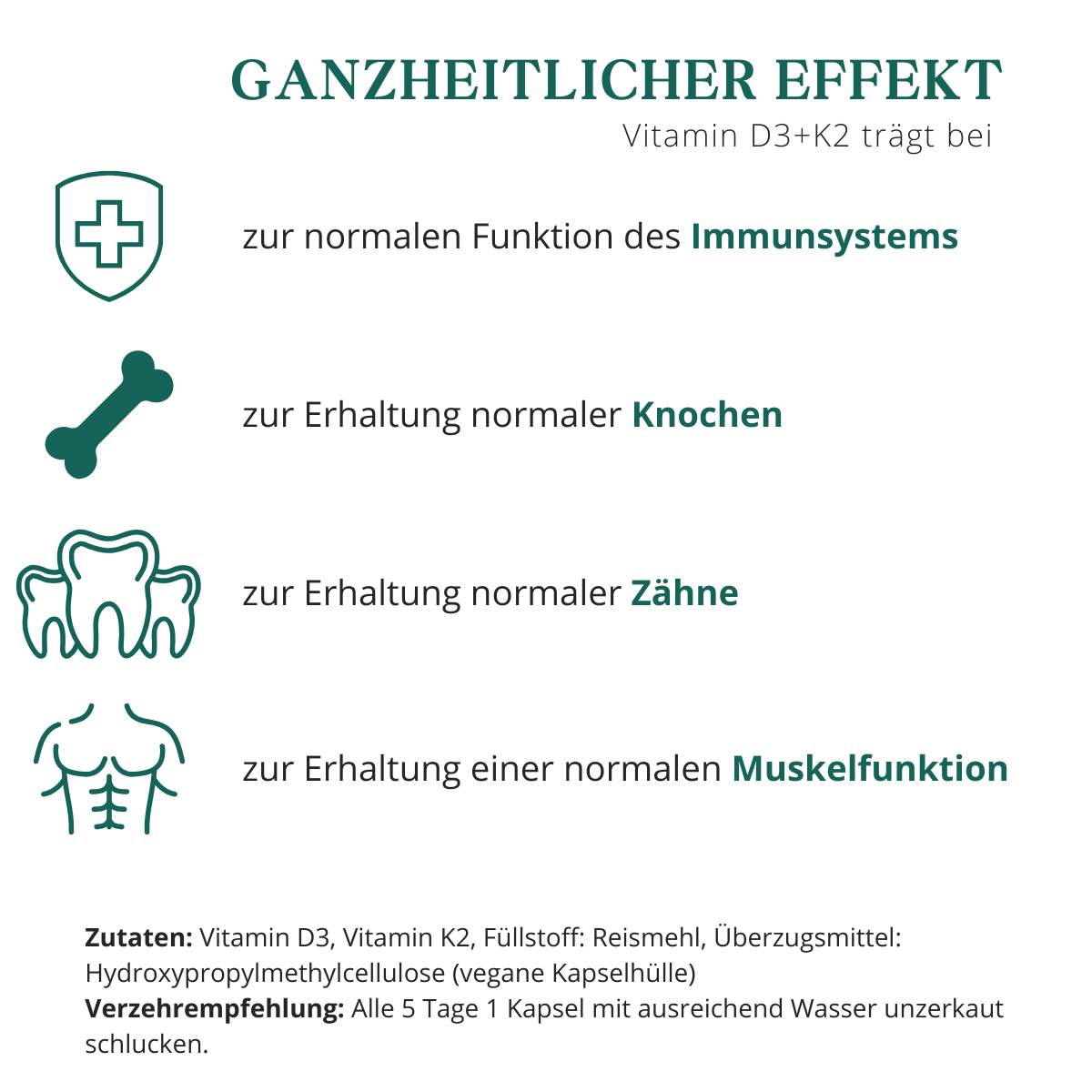
Vitamin D and vitamin K both contribute to the maintenance of normal bones, which is why they are often combined. For the raw materials, we pay attention to vegan quality and the natural all-trans form of vitamin K2.
Vegan instead of wool grease
Conventional vitamin D3 is derived from lanolin, the wool grease from sheep. This is vegetarian, but not vegan. Anyone who values this should therefore look for the ‘vegan’ label. We use Vitamin D3V®, a certified vegan vitamin D3 made from non-animal raw materials.
Vitamins K1 and K2
Vitamin K1 is found primarily in green vegetables such as kale, spinach and broccoli. Vitamin K2 is found in animal-based and fermented foods, such as cheese or the Japanese dish natto. Both forms are types of vitamin K.
What is all-trans MK-7?
MK-7 (menaquinone-7) is a form of vitamin K2. We use the branded raw material K2VITAL® in its all-trans form. This is the molecular form that also occurs naturally in food.
Caution with anticoagulants
Vitamin K contributes to normal blood clotting. Anyone taking vitamin K antagonists such as phenprocoumon (e.g. Marcumar®) should maintain a consistent intake of vitamin K. You should therefore only take vitamin K-containing supplements after consulting your doctor.
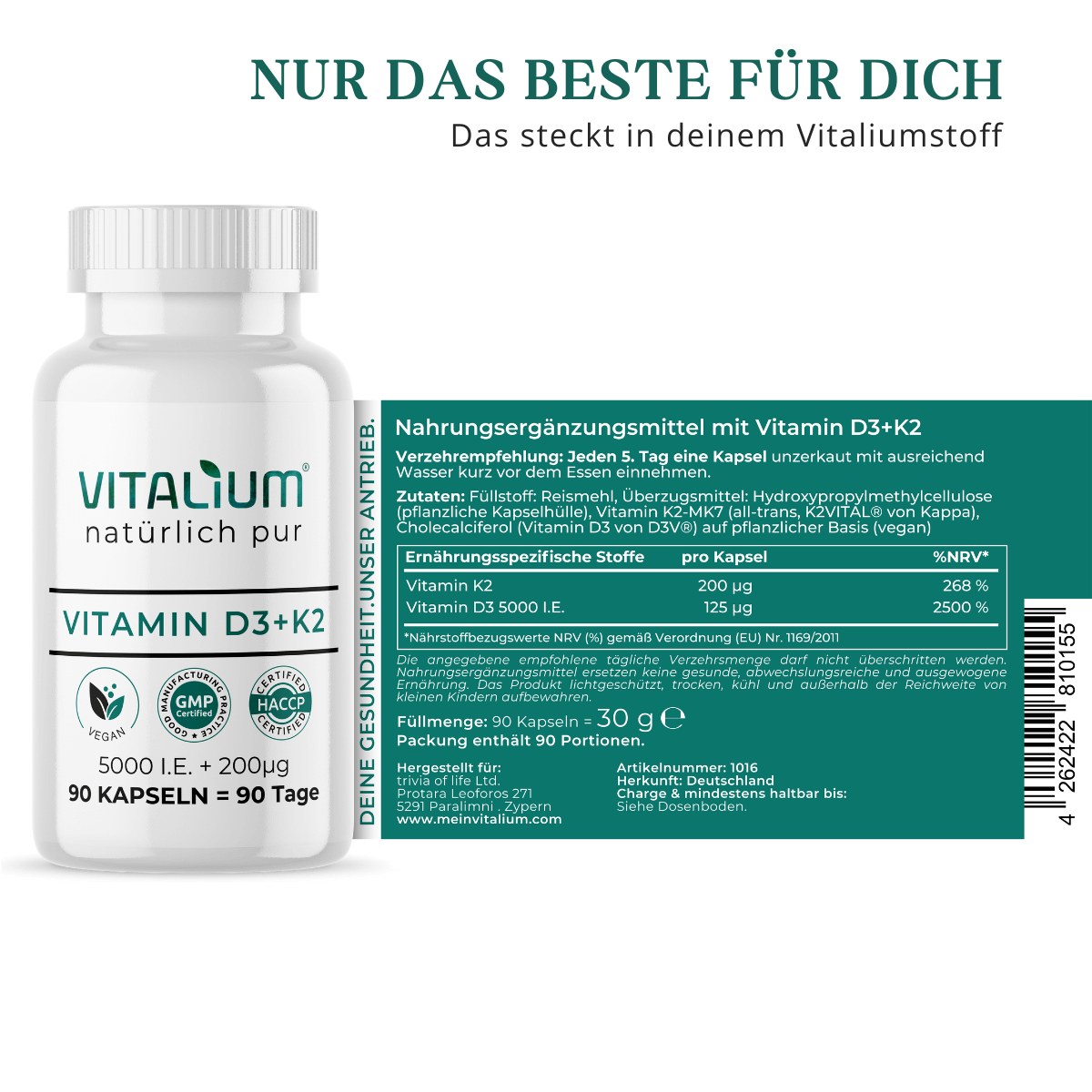
Transparent labelling
| Nährstoff | 1 capsule | % NRV* |
|---|---|---|
| Vitamin D3 | 125 µg (5,000 IU) | 2.500 % |
| Vitamin K2 | 200 µg | 268 % |
* NRV = Nutrient Reference Value according to Regulation (EU) No 1169/2011. One capsule is intended for five days.
Ingredients & product information
Name: Food supplement containing vitamin D3 and vitamin K2
Net quantity: 90 capsules = 30 g, pack contains 90 servings
Ingredients: Bulking agent: rice flour, coating agent: hydroxypropyl methylcellulose (vegetable capsule shell), vitamin K2-MK7 (all-trans, K2VITAL® from Kappa), cholecalciferol (vitamin D3 from D3V®) plant-based (vegan)
Raw materials: Vitamin D3V® (vegan), K2VITAL® (all-trans menaquinone-7)
Recommended intake: Take one capsule every 5 days, whole, with plenty of water, shortly before a meal.
Warnings: Do not exceed the stated recommended daily dose. Food supplements should not be used as a substitute for a varied and balanced diet and a healthy lifestyle. Keep out of the reach of young children.
Important: If taking anticoagulant medication, only consume this product after consulting your doctor.
Storage: Store tightly sealed in a cool, dry place, protected from light.
Origin: Germany
Manufactured for: trivia of life Ltd., Protara Leoforos 271, 5291 Paralimni, Cyprus
What vitamins D and K contribute
Several health claims relating to vitamins D and K are authorised in the EU.
Vitamin D
125 µg per capsule
Vitamin K
200 µg per capsule
Health claims in accordance with Regulation (EU) No 432/2012. Food supplements should not be used as a substitute for a varied and balanced diet and a healthy lifestyle.

Background
Vitamin D3 (cholecalciferol) is the form that the skin also produces when exposed to sunlight.
Converting IU and µg
Vitamin D is measured in micrograms (µg) or International Units (IU). 1 µg is equivalent to 40 IU. Therefore, 125 µg is 5,000 IU, and 25 µg is 1,000 IU.
Fat-soluble and storable
Vitamins D and K are fat-soluble. The body can store vitamin D, which is why a consistently excessive intake can build up over time. This is precisely why the interval between doses is important.
Vitamin D from food
Significant amounts are found primarily in oily fish such as salmon, herring or mackerel, as well as in egg yolks and mushrooms that have been exposed to sunlight.

Added value in everyday life
Kale and broccoli provide vitamin K1, while mushrooms provide a small amount of vitamin D. Prepared with a little oil, this stir-fry makes a good meal for a vitamin intake day.
Ingredients
Preparation
Good to know: The vitamin D content of mushrooms depends, amongst other things, on how much UV light they have been exposed to, and varies considerably. This recipe idea is intended as inspiration; nutrient contents vary depending on the ingredients.
Product & quality

Vegan
Vegan D3 instead of lanolin, in an HPMC capsule shell.

GMP
Manufactured in accordance with GMP quality standards.

HACCP
Manufactured under HACCP-controlled processes.
Branded raw materials
Vitamin D3V® and K2VITAL®, vitamin K2 as all-trans MK-7.
No. 5,000 IU (125 µg) of vitamin D3 is the amount per capsule. According to the recommended intake, you take one capsule every five days; mathematically, that is an average of 25 µg (1,000 IU) of vitamin D3 and 40 µg of vitamin K2 per day.
One capsule every fifth day, swallowed whole with enough water, shortly before a meal. Vitamins D and K are fat-soluble, so a meal containing some fat is a good fit. To make sure you don’t forget the interval, it’s best to set a recurring reminder every five days.
One jar contains 90 capsules. At one capsule every five days, it lasts 450 days in theory, so just under 15 months. Do still keep an eye on the best-before date on the jar.
The Nutrient Reference Value (NRV) of 5 µg is an EU-wide benchmark for labelling. The DGE reference value of 20 µg indicates how much vitamin D should be consumed via the diet, excluding the amount produced by the body through the skin. The EFSA upper limit of 100 µg describes the maximum amount that adults should consume daily from all foods and supplements over the long term.
From then on, stick to the five-day interval again. If you have taken several extra capsules or are unsure, ask your pharmacist or doctor before the next intake.
IU stands for International Units. For vitamin D, 1 µg is equal to 40 IU. A capsule containing 125 µg therefore contains 5,000 IU.
During the summer months, your skin can produce vitamin D naturally if you spend time outdoors regularly, provided your face, hands and parts of your arms and legs are uncovered. How long this takes depends largely on your skin type, the season, the time of day and UV radiation. You should always avoid getting sunburnt. During the winter months, the sun in Germany is usually not strong enough to allow for sufficient production.
It’s a good idea, particularly before taking supplements for a prolonged period. By measuring your 25-OH-vitamin D blood level, your doctor can assess how well-supplied you are and whether supplementation is suitable for you. Professional bodies recommend vitamin D supplements particularly when a deficiency has been diagnosed.
According to the DGE, BfR and MRI, this mainly applies to people who rarely go outside or only spend time outdoors while fully covered, people with darker skin, and older people who are mobility-impaired or in need of care.
Vitamin D and vitamin K both contribute to the maintenance of normal bones, which is why they are often combined. In addition, vitamin D contributes to normal absorption/utilisation of calcium and phosphorus, and vitamin K contributes to normal blood clotting. We cannot promise any benefit of the combination beyond this. According to the BfR, taking high doses together has hardly been studied so far.
Yes. Conventional vitamin D3 is obtained from lanolin, the wool grease of sheep, and is therefore only vegetarian. We use Vitamin D3V®, a certified vegan vitamin D3. This is combined with K2VITAL® (vitamin K2 as all-trans MK-7), rice flour as a filler and a vegan HPMC capsule shell.
Add up the doses of all supplements, including multivitamin products. Our multivitamin complex, for example, also contains vitamin D3 and K2. If you wish to take several vitamin D supplements, it is best to discuss this with your doctor.
Vitamin K counteracts vitamin K antagonists such as phenprocoumon. If you are taking such medication, your vitamin K intake should be as consistent as possible. You should therefore only take the capsules after consulting your doctor.
For adults who wish to supplement their intake of vitamins D and K, ideally after consulting their doctor. The dosage is not intended for children or adolescents. If you are pregnant or breastfeeding, have conditions such as kidney disease, or are taking medication regularly, please consult your doctor before taking these capsules.
Store the jar tightly closed, in a dry, cool place away from light, and check the best-before date.
In the Q&As from the DGE, BfR and MRI as well as from the German Nutrition Society on the reference values for nutrient intake.
👍👍👍
Gehört in jede gute Hausapotheke das Zeug. Lieferung in 2 Tagen mit DHL, bin ich zufrieden mit
Ein Stück Siziliens daheim, das erfreut mich bei jedem Kochen von neuem, danke.
Bisher kann ich nicht klagen. Habe es bei Mundschleimhaut angewandt und es hat nicht enttäuscht
Preis Leistung soweit top - Lösung hat die gewünschte gelbliche Farbe und den bekannten Geruch, Verpackugn sehr hochwertig, viel besser als alles von Amazon bisher!
Das Produkt kam schnell an und war sorgfältig verpackt.
Mir gefällt, dass hier auf einen bekannten Markenrohstoff gesetzt wird.
Hochwertiger Rohstoff und angenehme Kapselgröße.
Sehr aromatisch und schön verpackt.
ich trinke täglich ca. 1 Esslöffel davon oder gebe die Menge meinem Frühstück hinzu (ohne erhitzen!), aufgrund der vielen polyphenole enorm wertvoll für eine gesunde fettaufnahme
Die Dosierung passt für mich sehr gut in den Alltag.
Ich habe das erste mal bestellt bei euch, Lieferung kam zügig, die Kapseln haben genau die Dosierung die ich täglich benötige. 5000 IE D3 plus 200my K2. Die Kapseln reichen für 90 Tage, so muss ich nicht so oft bestellen. Zur Wirkung kann ich nicht viel sagen, da ich schon seit Jahren D3 nehme und seit dem auch nie mehr krank war. Die Kapseln sind einfach zu schlucken. Also alles gut.
Sehr schnelle Lieferung!
Fast and Furious
Ihr habt uns trotz Lieferschwierigkeiten sehr dabei geholfen das das Paket endlich angekommen ist. Da könnt ihr ja nichts dafür. Durch den ständigen Kontakt hat man sich verstanden gefühlt auch wenn man Wut hatte sein Paket nicht zu erhalten. Danke dafür.

Vitamin D3 + K2 capsules
90 vegan capsules with Vitamin D3V® and K2VITAL® (MK-7). Recommended intake: one capsule every five days.
Always stocked up on time: save 5% with Subscribe & save
All prices include VAT, plus shipping.