Polyphenols
Content clearly stated
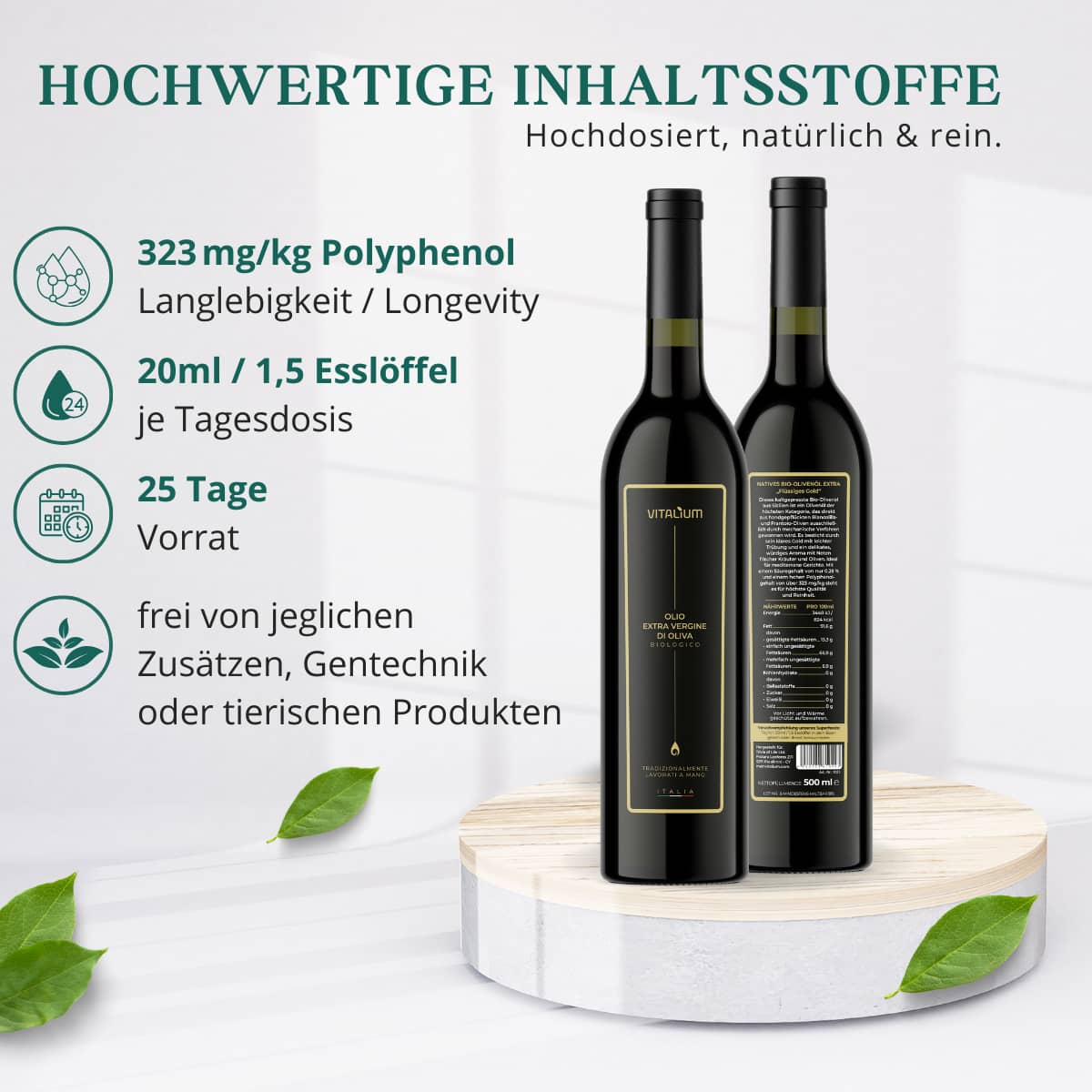
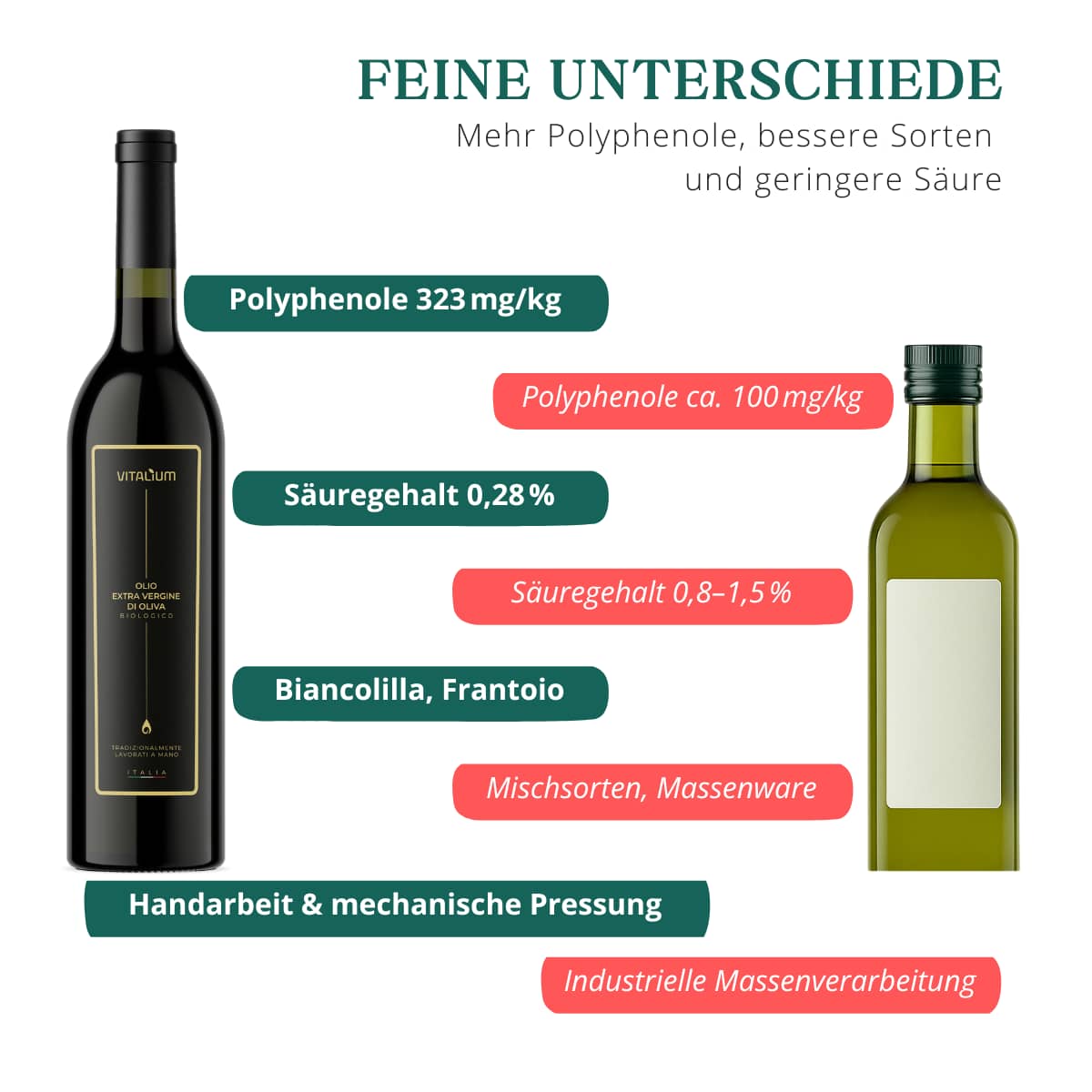
A polyphenol content of 323 mg/kg has been determined for our oil. You can check for each oil whether and how this value is stated.




Pay securely and easily with:


Your payment information is processed securely. We do not store credit card details nor have access to your credit card information.

Polyphenols explained simply
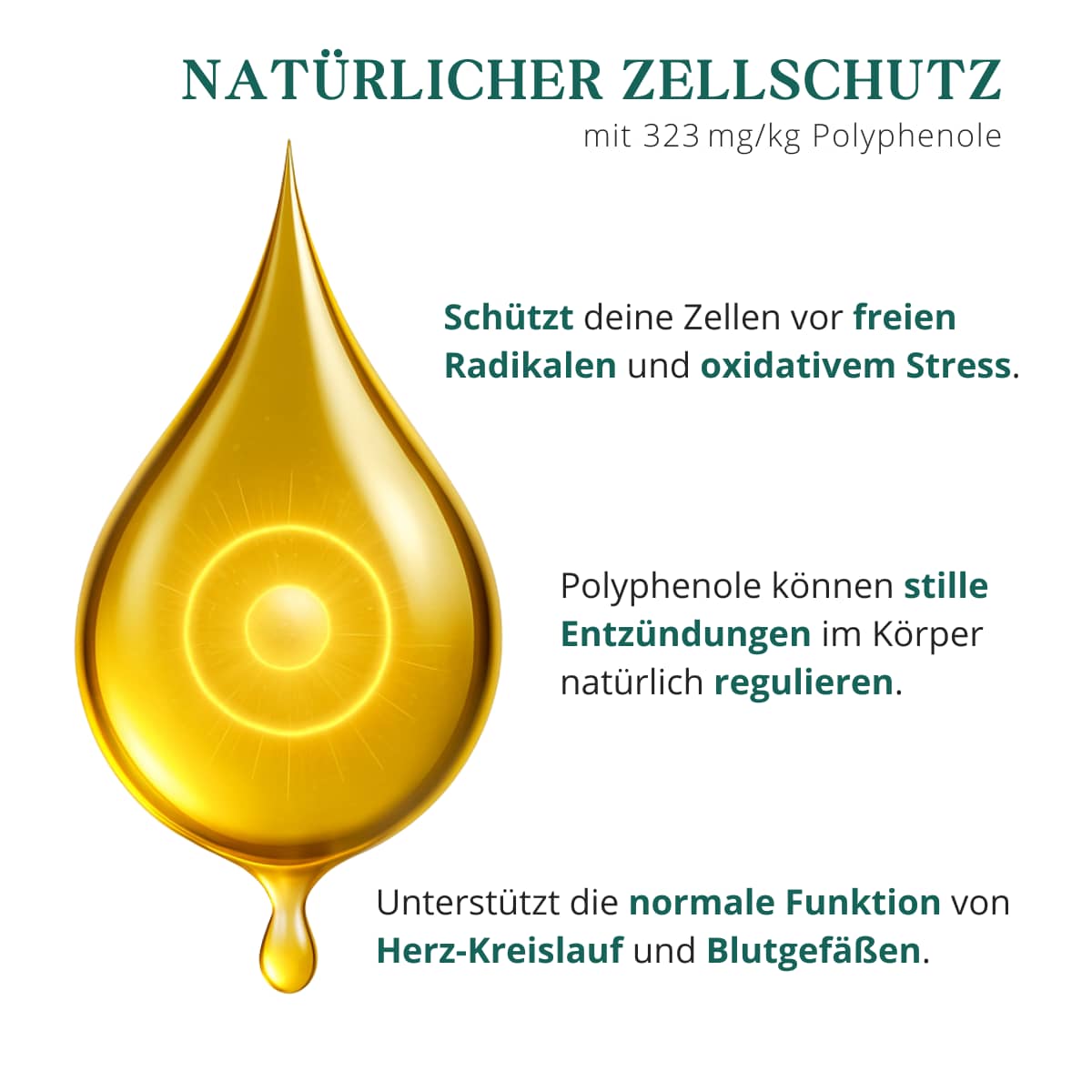
Polyphenols are natural plant compounds that form in the olive and are transferred into the oil during pressing. The amount present in the finished oil varies considerably from one oil to another.
You can taste them
A fresh, grassy aroma, a slight bitterness and a peppery tingle in the throat: these typical characteristics of olive oil are partly due to polyphenols. Very mild, neutral oils usually contain fewer of them.
Every oil is different
The amount of polyphenols that end up in the oil and are retained depends, amongst other things, on the variety, harvest time, processing and storage. A measured value makes this difference apparent.
They protect the oil itself
In the oil, polyphenols slow down oxidation, i.e. the process of going rancid. This means that the flavour and freshness are preserved for longer.
What to look out for
Many olive oils carry the same ‘extra virgin’ grade. These points will help you compare them, and here’s how our oil measures up.
Polyphenols
Content clearly stated
A polyphenol content of 323 mg/kg has been determined for our oil. You can check for each oil whether and how this value is stated.
Origin
Origin and varieties specified
Biancolilla and Frantoio olives from Sicily. If a label simply states ‘from the EU’, the oil may come from several countries.
Harvest
Hand-picked
Hand-picking protects the fruit. Damaged olives oxidise more quickly, which can reduce both flavour and polyphenol content.
Cultivation
Certified organic
The olives are organically grown.
Quality grade
Extra virgin
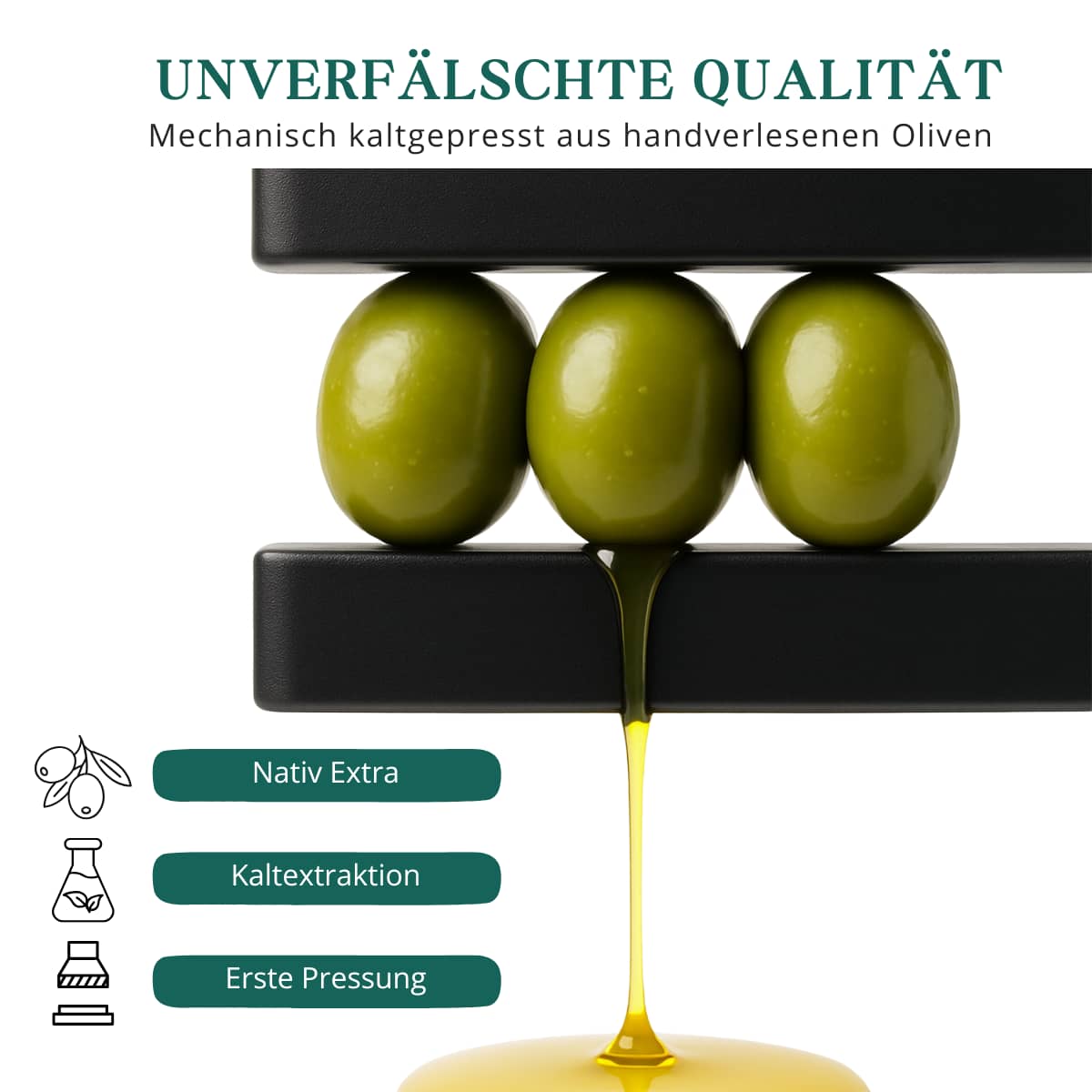
The highest quality grade for olive oil: extracted directly from olives using exclusively mechanical methods.
Use
Made for cold dishes
Use it cold: in salads and dips, on bread or drizzled over finished dishes. Don’t heat it, as heat affects its delicate flavour and the polyphenols.
Polyphenols in figures
The polyphenol content of olive oil is usually given in milligrams per kilogram. This is the amount, in mathematical terms, contained in the quantities you actually use.
mg per kilogram
Analytical value for the oil
mg per serving
20 ml
mg per tablespoon
15 ml
Calculated using a density of 0.915 g/ml. The polyphenol content is an analytical value. It depends on the measurement method and decreases with storage time.
Understanding the label
At first glance, polyphenol information seems straightforward. Three points help when comparing.
Per kilogram or per serving?
Some suppliers state the content per kilogram, others per serving. 323 mg/kg corresponds to around 5.9 mg in 20 ml. So always compare the same reference unit.
Which polyphenols?
Olive oil contains various polyphenols, such as hydroxytyrosol, tyrosol and their derivatives. Depending on the analysis, either all of them or only certain ones are measured. Values obtained using different methods are therefore only comparable to a limited extent.
A value tied to a point in time
Polyphenols degrade over time due to light, heat and oxygen. An analytical value describes the oil at the time of measurement. Proper storage helps to preserve as much of it as possible.

Origin & production
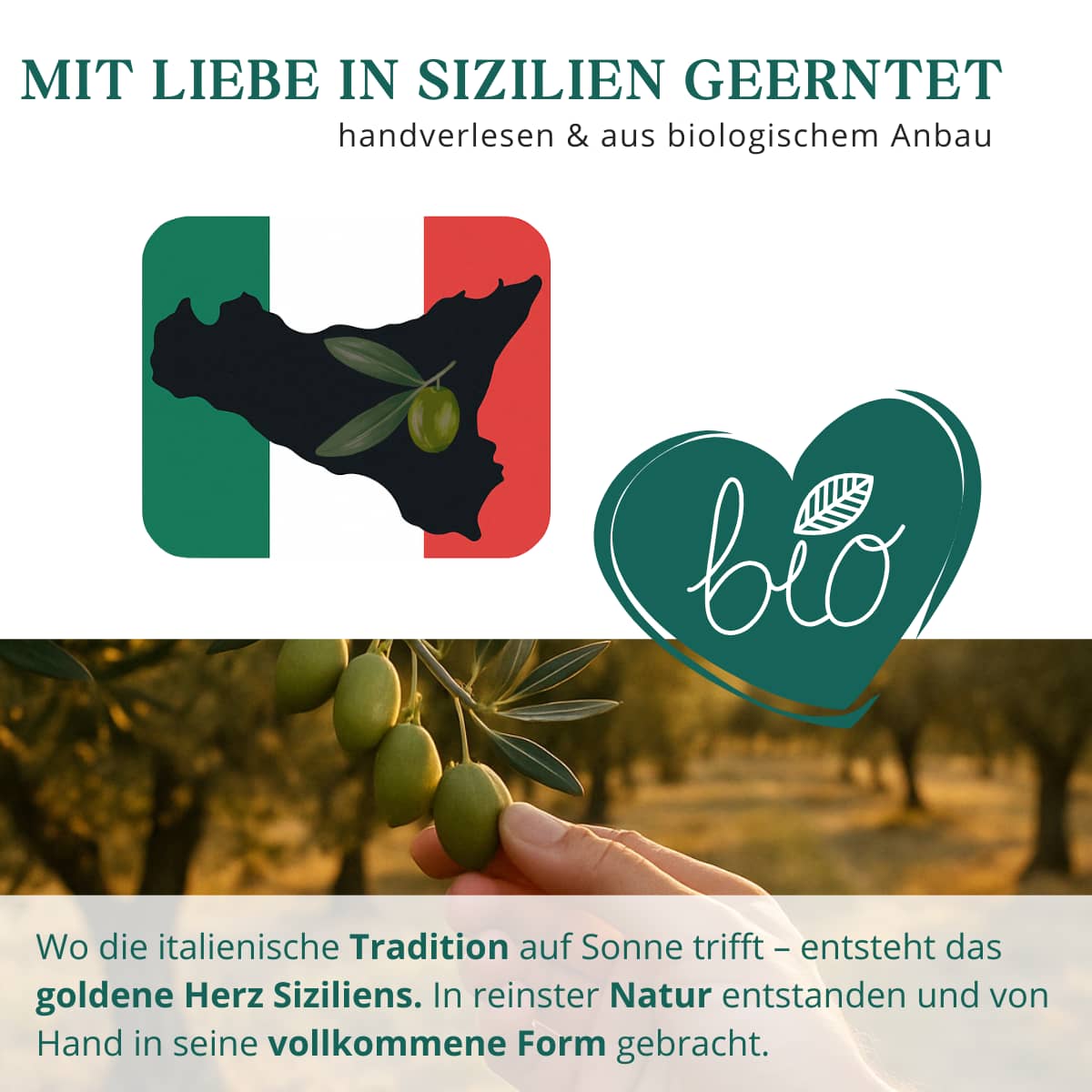
Our organic olive oil comes from Sicily.
Two olive varieties
The oil is extracted from Biancolilla and Frantoio olives. Biancolilla is a traditional Sicilian variety, while Frantoio originates from Tuscany and is now cultivated in many regions of Italy.
Hand-picked and mechanically extracted
The olives are picked by hand. The oil is extracted exclusively using mechanical methods, without any chemical treatment. This is a prerequisite for the ‘extra virgin’ grade.
From organic cultivation
The olives come from certified organic cultivation. The oil is a clear golden colour with a slight cloudiness, as is typical of unrefined oils.
Background
The polyphenol content of an olive oil is determined by the entire process, from the tree to the kitchen.
Variety
Olive varieties differ significantly in their polyphenol content. The choice of variety lays the foundation.
Harvest time
Olives harvested early, while still green, generally contain more polyphenols than fully ripe ones. The oil then has a stronger, more bitter flavour.
Processing
Rapid processing after harvesting and gentle mechanical extraction help to preserve the polyphenols.
Storage
Light, heat and oxygen break down polyphenols. You should therefore store the oil in a dark, cool place, kept tightly sealed, and use it up quickly once opened.
Fatty acid profile
Around three-quarters of the fatty acids in our olive oil are monounsaturated. The most important fatty acid in olive oil is oleic acid.
Values according to the nutritional table. Around 85% of the fatty acids are unsaturated.
Use
Our serving suggestion: 20 ml, for example drizzled over salad, vegetables or bread, in dips or eaten straight from the spoon.

20 ml
Serving suggestion
One bottle contains 25 servings of 20 ml each.
On its own or over cold dishes
Drizzle the oil over salads, vegetables, pulses or bread, stir it into dips or enjoy a spoonful on its own.
Don’t heat it
Don’t fry with this oil or heat it, as heat affects its delicate flavour and the polyphenols. With warm dishes, drizzle it over the finished food at the very end.
Store in a cool, dark place
Close the bottle after each use and store it away from light and heat, not next to the hob.
Store away from light and heat.
Authorised claim
Our olive oil is rich in unsaturated fatty acids: around 85% of its fatty acids are unsaturated.
Fatty acids & cholesterol
Health claim in accordance with Regulation (EU) No 432/2012. A varied, balanced diet and a healthy lifestyle are important.
Transparent labelling
| Nährstoff | per 100 ml | per 20 ml |
|---|---|---|
| Energy | 3448 kJ / 824 kcal | 690 kJ / 165 kcal |
| Fat | 91,6 g | 18,3 g |
| – of which saturated fatty acids | 13,3 g | 2,7 g |
| – of which monounsaturated fatty acids | 66,9 g | 13,4 g |
| – of which polyunsaturated fatty acids | 6,9 g | 1,4 g |
| Carbohydrates | 0 g | 0 g |
| – of which sugars | 0 g | 0 g |
| Dietary fibre | 0 g | 0 g |
| Protein | 0 g | 0 g |
| Salt | 0 g | 0 g |
Information per 100 ml as stated on the label. The values per 20 ml are calculated from this.
Product information
Name: Extra virgin olive oil from certified organic cultivation. An olive oil of the highest category, obtained directly from olives using exclusively mechanical processes.
Polyphenol content: over 323 mg/kg
Net quantity: 500 ml
Recommended daily intake: Add 20 ml (1.5 tablespoons) to your food daily or consume directly.
Storage: Store away from light and heat.
Note: Do not heat.
Origin: Sicily, Italy
Manufactured for: trivia of life Ltd., Protara Leoforos 271, 5291 Paralimni, Cyprus


Added value in everyday life
A quick dip where the olive oil is served uncooked. Goes well with toasted bread, vegetable sticks or as a side dish.
Ingredients
Preparation
Good to know: This recipe idea is intended as inspiration; nutrient content varies depending on the ingredients.
Product & quality
Certified organic
Olives from certified organic cultivation.

Vegan
Purely plant-based, with no additives.
servings of 20 ml
500 ml per bottle.
It depends on what matters to you. If you’re looking for an oil for cold dishes, it’s worth taking a closer look at the label: Is the polyphenol content stated? Are the origin and olive varieties specified? Are the olives organically grown? For our oil, you’ll find this information here on the page.
Cold: over salad, vegetables, pulses or bread, in dips and dressings, drizzled over finished dishes or straight from the spoon. Don’t heat it. As a serving, we suggest 20 ml.
We advise against it. Heat affects the delicate flavour and the polyphenols of this oil. So use it cold, for example in salads, dips and on bread, or drizzle it over the finished dish. For frying, you’re better off using a different oil.
A slight scratchy sensation in the throat and a pleasant bitterness are common with virgin olive oil. These are caused, amongst other things, by certain polyphenols and are not a sign of poor quality.
Polyphenols are secondary plant compounds. In olive oil, these include hydroxytyrosol, tyrosol and their derivatives. They characterise the flavour and shelf life of the oil.
323 mg of polyphenols were measured in one kilogram of oil. This equates to around 5.9 mg in a 20 ml portion and around 4.4 mg in a tablespoon.
Suppliers sometimes state the content per kilogram and sometimes per serving. In addition, analytical methods capture different polyphenols. And the content decreases with storage time. The values of different oils are therefore only comparable to a limited extent.
No. Polyphenols break down over time due to light, heat and oxygen. The stated value reflects the oil’s composition at the time of analysis. Storing the oil in a dark, cool place and using it up quickly after opening helps.
Extra virgin olive oil is the highest quality grade. It is obtained directly from olives using exclusively mechanical processes, has a free fatty acid content of no more than 0.8% and must be fruity and free from defects in sensory evaluation.
A slight cloudiness is caused by fine particles from the olives and is normal in unrefined oils. Over time, these may settle at the bottom of the bottle.
Keep it tightly sealed, in a dark and cool place – for example, in a larder cupboard, not next to the hob. If stored in the fridge, the oil may become flocculent. This is harmless and will clear up again at room temperature.
Check the best-before date on the bottle. Once opened, it’s best to use the oil up quickly so that the flavour and polyphenols are preserved as well as possible. One bottle contains 25 servings of 20 ml each.
20 ml contains around 165 kcal and 18.3 g of fat. If you use the oil regularly, it’s best to use it to replace other fats rather than consuming it on top of your usual diet.
The olives come from Sicily. The Biancolilla and Frantoio varieties, grown to certified organic standards, are used.
Yes. It consists exclusively of olive oil.
Hand-picking is gentle on the fruit. Damaged olives oxidise more quickly, which can reduce flavour and polyphenol content. How many polyphenols end up in the oil also depends on the variety, the time of harvest, processing and storage.
👍👍👍
Gehört in jede gute Hausapotheke das Zeug. Lieferung in 2 Tagen mit DHL, bin ich zufrieden mit
Ein Stück Siziliens daheim, das erfreut mich bei jedem Kochen von neuem, danke.
Bisher kann ich nicht klagen. Habe es bei Mundschleimhaut angewandt und es hat nicht enttäuscht
Preis Leistung soweit top - Lösung hat die gewünschte gelbliche Farbe und den bekannten Geruch, Verpackugn sehr hochwertig, viel besser als alles von Amazon bisher!
Das Produkt kam schnell an und war sorgfältig verpackt.
Mir gefällt, dass hier auf einen bekannten Markenrohstoff gesetzt wird.
Hochwertiger Rohstoff und angenehme Kapselgröße.
Sehr aromatisch und schön verpackt.
ich trinke täglich ca. 1 Esslöffel davon oder gebe die Menge meinem Frühstück hinzu (ohne erhitzen!), aufgrund der vielen polyphenole enorm wertvoll für eine gesunde fettaufnahme
Die Dosierung passt für mich sehr gut in den Alltag.
Ich habe das erste mal bestellt bei euch, Lieferung kam zügig, die Kapseln haben genau die Dosierung die ich täglich benötige. 5000 IE D3 plus 200my K2. Die Kapseln reichen für 90 Tage, so muss ich nicht so oft bestellen. Zur Wirkung kann ich nicht viel sagen, da ich schon seit Jahren D3 nehme und seit dem auch nie mehr krank war. Die Kapseln sind einfach zu schlucken. Also alles gut.
Sehr schnelle Lieferung!
Fast and Furious
Ihr habt uns trotz Lieferschwierigkeiten sehr dabei geholfen das das Paket endlich angekommen ist. Da könnt ihr ja nichts dafür. Durch den ständigen Kontakt hat man sich verstanden gefühlt auch wenn man Wut hatte sein Paket nicht zu erhalten. Danke dafür.

Organic extra virgin olive oil
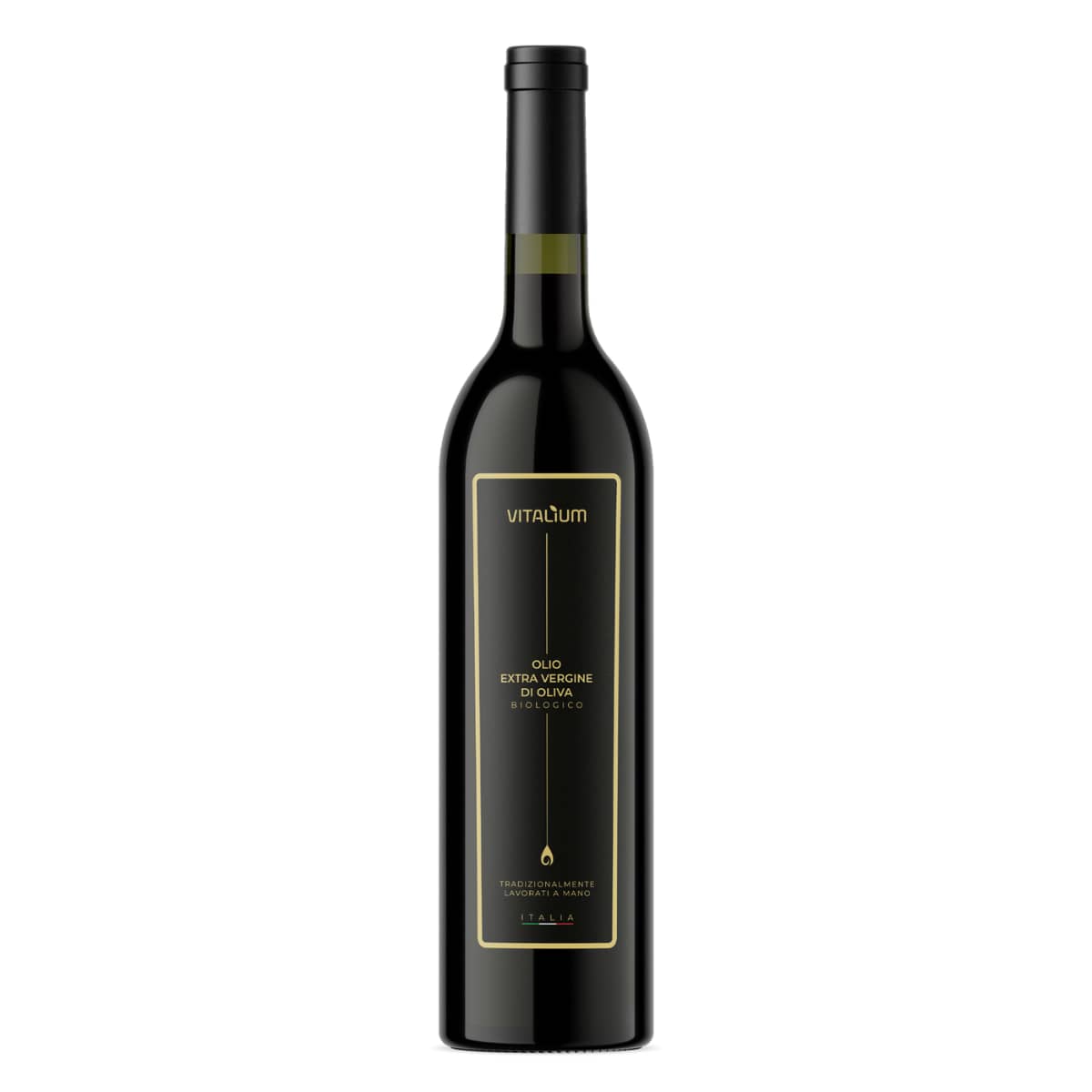
500 ml organic extra virgin olive oil made from Biancolilla and Frantoio olives, with a measured polyphenol content.
Always stocked up on time: save 5% with Subscribe & save
All prices include VAT, plus shipping.