Measure out 2 g
Fill the measuring scoop provided to the ¼ mark. This is equivalent to 2 g of glycine. You can be more precise using a precision balance.


Pay securely and easily with:


Your payment information is processed securely. We do not store credit card details nor have access to your credit card information.
Dosage
Stir 2 g of glycine into a drink of your choice once a day and drink it.

2 g
daily
1 measuring scoop filled to the ¼ mark. One pouch contains 250 daily servings.
Measure out 2 g
Fill the measuring scoop provided to the ¼ mark. This is equivalent to 2 g of glycine. You can be more precise using a precision balance.
Stir in
Stir the powder into a glass of water, tea or a smoothie. It dissolves quickly.
Store in a dry place
Seal the pouch tightly after each use. Moisture causes the powder to clump.
Do not exceed the stated recommended daily dose. Food supplements should not be used as a substitute for a varied and balanced diet and a healthy lifestyle. Keep out of the reach of young children.

Good to know
You come across glycine every day, particularly in protein-rich foods. Here are the key facts in brief.
The smallest protein building block
Glycine is the smallest protein-forming amino acid. Its side chain consists of a single hydrogen atom.
For cold and hot drinks
Glycine dissolves well in water. Stir the powder into water or tea. You can also mix it into yoghurt or porridge.
Non-essential
The body can produce glycine itself. We also obtain it from protein-rich foods.
Diet
Gelatine is derived from collagen. In its characteristic sequences, every third amino acid is glycine, which is why gelatine contains a lot of it. Plant-based foods contain significantly less. All values are per 100 g.
Values per 100 g according to USDA FoodData Central (SR Legacy): Gelatins, dry powder, unsweetened (FDC 169599); Pumpkin and squash seed kernels, dried (170556); Peanuts, all types, raw (172430); Lentils, raw (172420); Oats (169705). The content depends on the food and its processing. Around 10.5 g of gelatine powder contains about 2 g of glycine. Gelatine is of animal origin; our glycine is vegan.
Transparent labelling
| Nährstoff | per daily serving (2 g) | % NRV* |
|---|---|---|
| Glycine | 2,000 mg | – |
* Nutrient Reference Values (NRVs) (%) in accordance with Regulation (EU) No 1169/2011. – No Nutrient Reference Value has been established for glycine.
Ingredients & product information
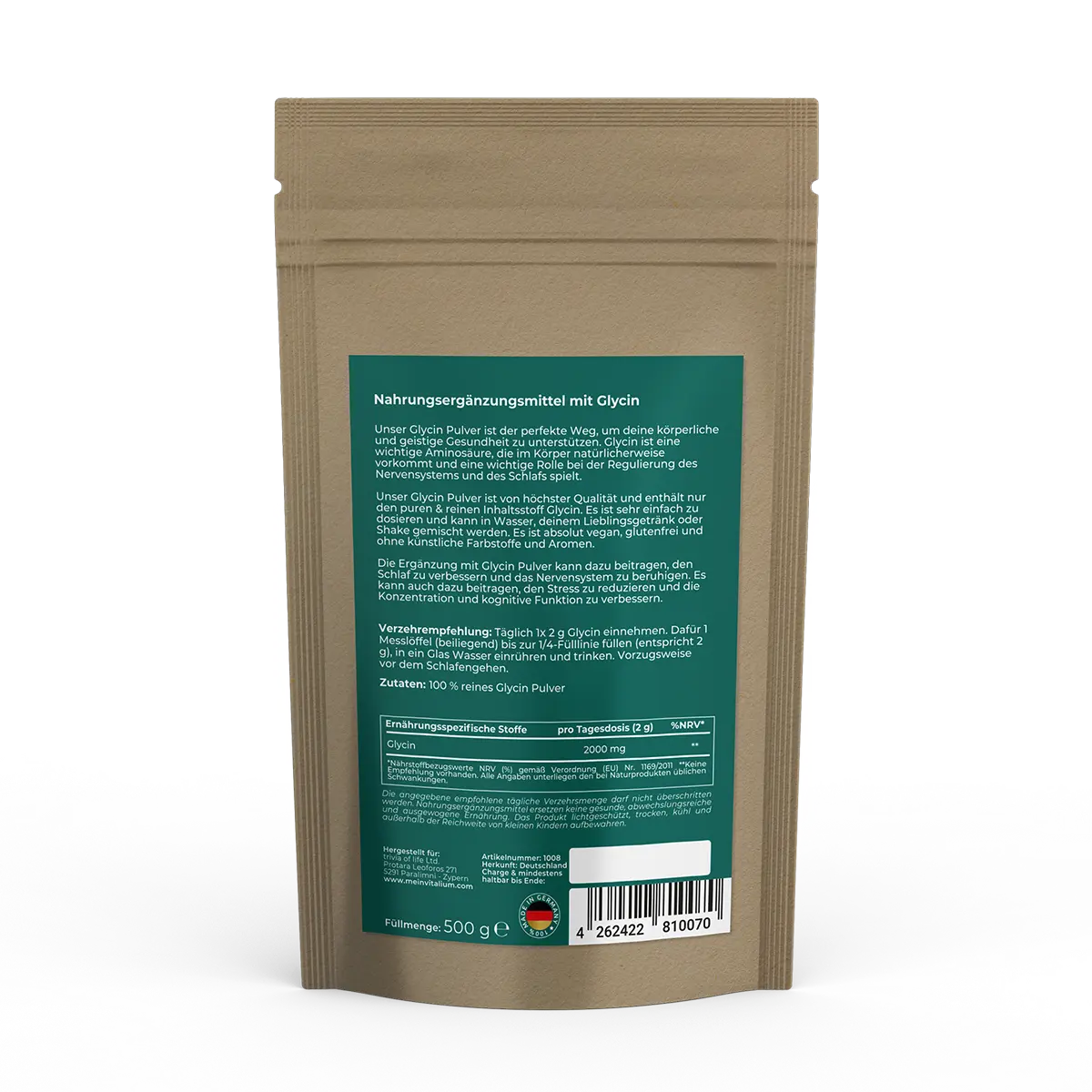
Name: Food supplement containing glycine
Net quantity: 500 g, 250 daily servings
Ingredients: 100% glycine
Recommended daily intake: Take 2 g of glycine once daily. To do this, fill 1 measuring scoop (supplied) up to the ¼ mark (equivalent to 2 g), stir into a glass of water and drink. Preferably before going to bed.
Warnings: Do not exceed the stated recommended daily dose. Food supplements should not be used as a substitute for a varied and balanced diet and a healthy lifestyle. Keep out of the reach of young children.
Storage: Store in a cool, dry place away from direct light.
Origin: Germany
Manufactured for: trivia of life Ltd., Protara Leoforos 271, 5291 Paralimni, Cyprus


Added value in everyday life
Glycine has a slightly sweet taste and dissolves well in warm drinks. In this cocoa, it replaces some of the sugar.
Ingredients
Preparation
Good to know: One cup already contains your entire daily serving of 2 g glycine. This recipe idea is intended as inspiration; nutrient contents vary depending on the ingredients.
Product & quality

Vegan
Contains no animal-derived ingredients.

GMP
Manufactured to GMP standards.

HACCP
Manufactured using an HACCP-based hygiene concept.
Glycine
One ingredient, without fillers or anti-caking agents.
Fill the measuring scoop provided up to the ¼ mark; this is equivalent to 2 g. If you want to be really precise, use a precision balance.
According to the recommended daily intake, take 2 g once a day, preferably before going to bed. Stir the serving into a glass of water or another drink of your choice, cold or warm. Do not take more than 2 g a day.
One pouch contains 500 g, which is 250 daily servings of 2 g each. At 2 g a day, it lasts 250 days, a little over eight months.
In water, tea, juice or smoothies, either cold or warm. You can also mix it into yoghurt, porridge or oat flakes.
Glycine is the smallest protein-forming amino acid. The body can produce it itself. In our diet, we mainly obtain it from protein-rich foods.
It is particularly abundant in gelatine, which is derived from collagen. It is also found in smaller quantities in pumpkin seeds, peanuts, pulses and cereals. The content depends on the food and how it has been processed.
No. No health claims are currently authorised for glycine in the EU. We therefore make no promises regarding its effects.
Yes. Our glycine contains no animal-derived ingredients. For comparison, gelatine also contains a lot of glycine but is of animal origin.
Our glycine powder is manufactured in Germany, in accordance with GMP standards and using an HACCP-based hygiene concept.
No. The only ingredient is glycine, with no fillers, anti-caking agents, flavourings or sweeteners.
Our product is intended for adults. If you are pregnant, breastfeeding or taking medication, please consult your doctor or pharmacist before use.
Please stick to the recommended daily intake of 2 g. Do not exceed this amount.
Moisture can cause lumps to form. This alone is not a reliable indicator of whether the powder is still fit for use. If you notice an unusual smell, discolouration or moisture ingress, please stop using it and contact us. Always store the pouch tightly sealed and in a dry place.
In a tightly sealed pouch, in a dry, cool place and out of the reach of young children. You’ll find the best-before date on the pouch.
👍👍👍
Gehört in jede gute Hausapotheke das Zeug. Lieferung in 2 Tagen mit DHL, bin ich zufrieden mit
Ein Stück Siziliens daheim, das erfreut mich bei jedem Kochen von neuem, danke.
Bisher kann ich nicht klagen. Habe es bei Mundschleimhaut angewandt und es hat nicht enttäuscht
Preis Leistung soweit top - Lösung hat die gewünschte gelbliche Farbe und den bekannten Geruch, Verpackugn sehr hochwertig, viel besser als alles von Amazon bisher!
Das Produkt kam schnell an und war sorgfältig verpackt.
Mir gefällt, dass hier auf einen bekannten Markenrohstoff gesetzt wird.
Hochwertiger Rohstoff und angenehme Kapselgröße.
Sehr aromatisch und schön verpackt.
ich trinke täglich ca. 1 Esslöffel davon oder gebe die Menge meinem Frühstück hinzu (ohne erhitzen!), aufgrund der vielen polyphenole enorm wertvoll für eine gesunde fettaufnahme
Die Dosierung passt für mich sehr gut in den Alltag.
Ich habe das erste mal bestellt bei euch, Lieferung kam zügig, die Kapseln haben genau die Dosierung die ich täglich benötige. 5000 IE D3 plus 200my K2. Die Kapseln reichen für 90 Tage, so muss ich nicht so oft bestellen. Zur Wirkung kann ich nicht viel sagen, da ich schon seit Jahren D3 nehme und seit dem auch nie mehr krank war. Die Kapseln sind einfach zu schlucken. Also alles gut.
Sehr schnelle Lieferung!
Fast and Furious
Ihr habt uns trotz Lieferschwierigkeiten sehr dabei geholfen das das Paket endlich angekommen ist. Da könnt ihr ja nichts dafür. Durch den ständigen Kontakt hat man sich verstanden gefühlt auch wenn man Wut hatte sein Paket nicht zu erhalten. Danke dafür.

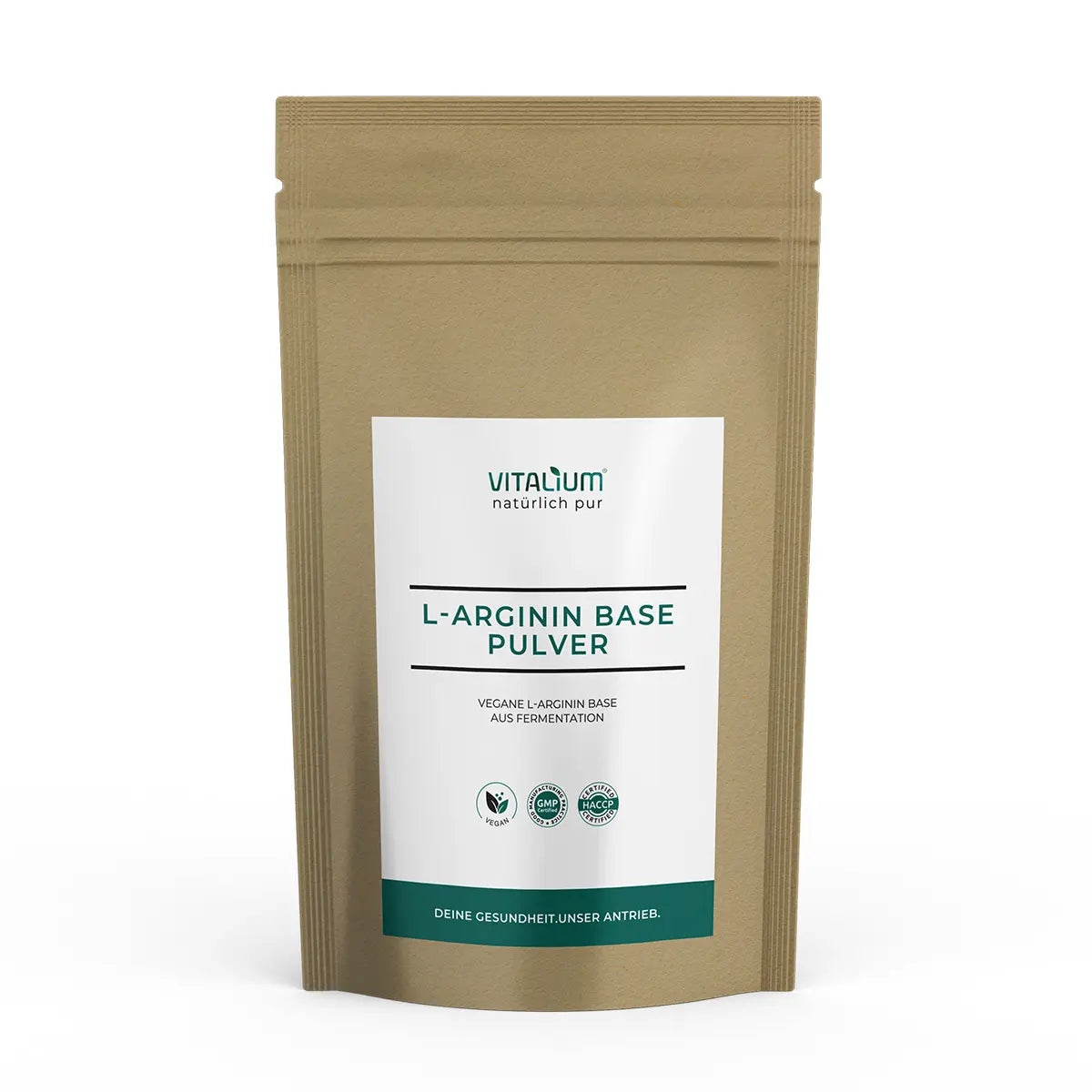
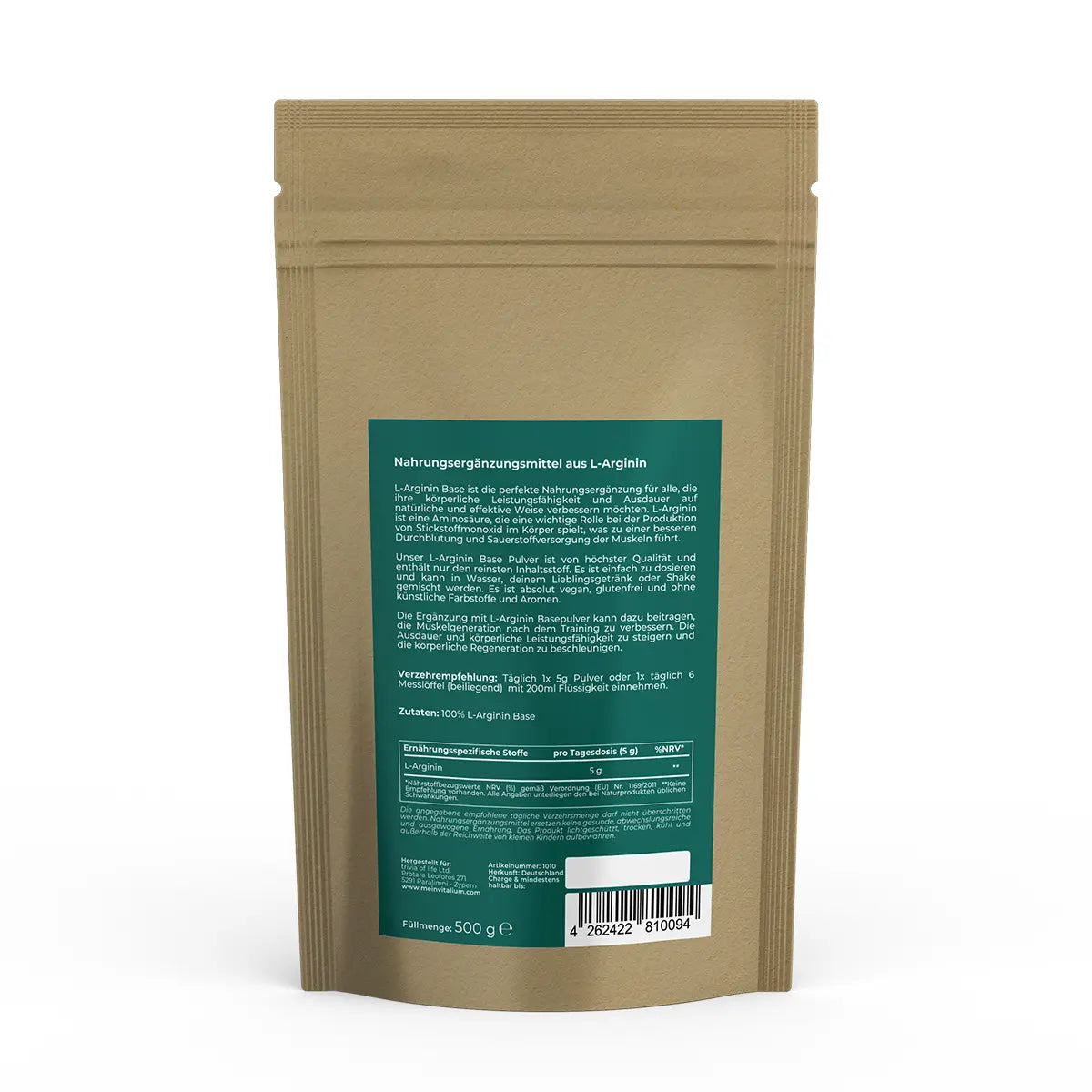
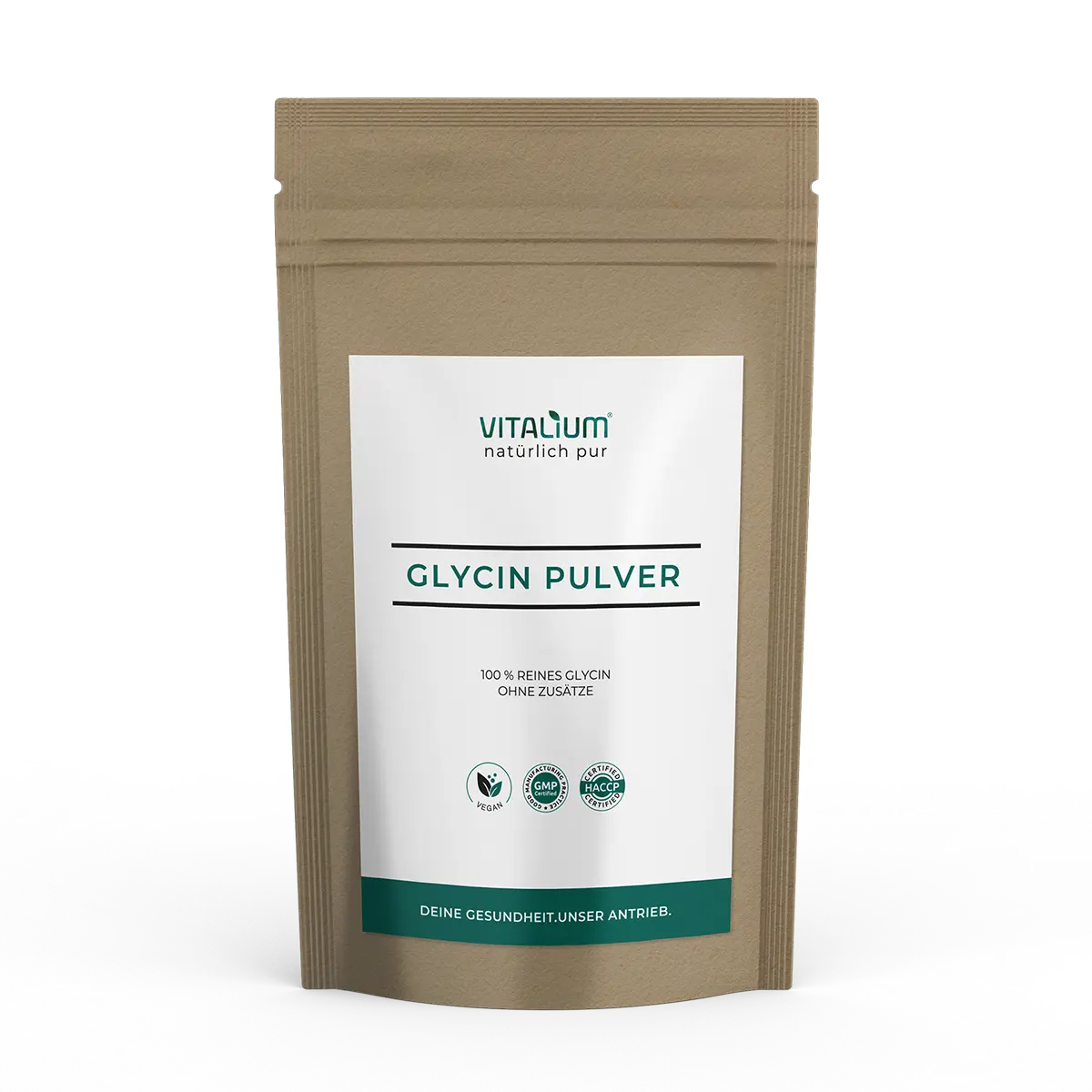
Glycine powder
500 g glycine powder with no additives, easily soluble in cold and warm drinks. Recommended daily intake: 2 g daily.
Always stocked up on time: save 5% with Subscribe & save
All prices include VAT, plus shipping.