Count the drops into the glass
Hold the pipette vertically over a glass of water and count the drops one by one.


Pay securely and easily with:


Your payment information is processed securely. We do not store credit card details nor have access to your credit card information.
Dosage
Add up to 10 drops to a glass of water daily and drink.

up to 10 drops
daily
One drop contains 1.5 mg of zinc. The drop calculator shows how much a specific number of drops amounts to.
Count the drops into the glass
Hold the pipette vertically over a glass of water and count the drops one by one.
Stir and drink
Stir briefly and drink the whole glass. If you have a sensitive stomach, it’s best to take the drops with or after a meal.
Close tightly
Screw the cap tightly onto the bottle after use and store it in a cool, dry place. One bottle contains approx. 3,400 drops.
Do not exceed the stated recommended daily dose. Food supplements should not be used as a substitute for a varied and balanced diet and a healthy lifestyle. Keep out of the reach of young children.
Drop calculator
Select a number of drops and see immediately how much zinc they contain and what proportion of the Nutrient Reference Value this corresponds to.
Default setting: maximum daily serving according to the recommended daily intake (10 drops). This selection is a calculation example, not a dosage recommendation.
BfR proposal 6.5 mg: Proposed maximum level of the German Federal Institute for Risk Assessment per daily serving of a food supplement. It is not legally binding and takes into account that zinc is also taken in through the diet. 100% NRV corresponds to the nutrient reference value of 10 mg zinc. Both markers are for context and are not a personal dosage target.

Good to know
Zinc is a trace element and is present in almost every cell in the body. It is a component of many enzymes and is required for numerous metabolic processes.
No specific storage site
The body cannot produce zinc itself and has no specific organ for storing it. Regular intake through the diet is therefore important.
Animal or plant sources
The body generally absorbs zinc more effectively from animal-based foods. In whole grains and pulses, phytate binds some of the zinc. Those following a vegetarian or vegan diet should therefore ensure they have an adequate zinc intake.
Requirements depend on phytate
Depending on phytate intake, the German Nutrition Society (DGE) gives 7 to 10 mg of zinc per day for adult women and 11 to 16 mg for men. At a medium phytate intake, the values are 8 mg and 14 mg. The values apply to total dietary intake.
Diet first
Zinc content per 100 g, with the amount in a typical serving below.
Values per 100 g according to USDA FoodData Central (SR Legacy): Pumpkin and squash seed kernels, dried (FDC 170556); Beef, ground, 93% lean, raw (173110); Cheese, Swiss (171251); Oats (169705); Lentils, raw (172420); Bread, whole-wheat (172688); Tofu, raw, firm (172475); Egg, whole, raw (171287). Soaking, sprouting and sourdough can reduce the phytate content of cereals and pulses.

Dosage explained
To help you understand the quantities correctly, here are the key points at a glance.
It’s the total amount that counts
In the EU, a tolerable upper limit of 25 mg of zinc per day applies to healthy adults. This refers to the total long-term intake from diet and food supplements. The figure is not a recommended intake, but a guideline for the upper limit.
BfR proposed maximum level
The BfR proposes a maximum of 6.5 mg of zinc per day for food supplements. Ten drops, at 15 mg, are above this. The proposal is not legally binding. Our recommended daily intake is up to ten drops. For context, a calculation example: four drops correspond to 6 mg of zinc. BfR proposed maximum levels
Do not double up
Do not take any other zinc-containing food supplements. Our multivitamin complex, for example, already contains 13 mg of zinc. Together with ten drops, that would be 28 mg, not counting your diet.
What zinc contributes
There are 18 authorised health claims for zinc in the EU. A daily serving of ten drops contains 15 mg of zinc.
Immune system & cell protection
Skin, hair & nails
Eyesight, bones & cognition
Fertility & hormones
Metabolism
Cells & protein
Health claims in accordance with Regulation (EU) No 432/2012. Food supplements should not be used as a substitute for a varied and balanced diet and a healthy lifestyle.
Transparent labelling
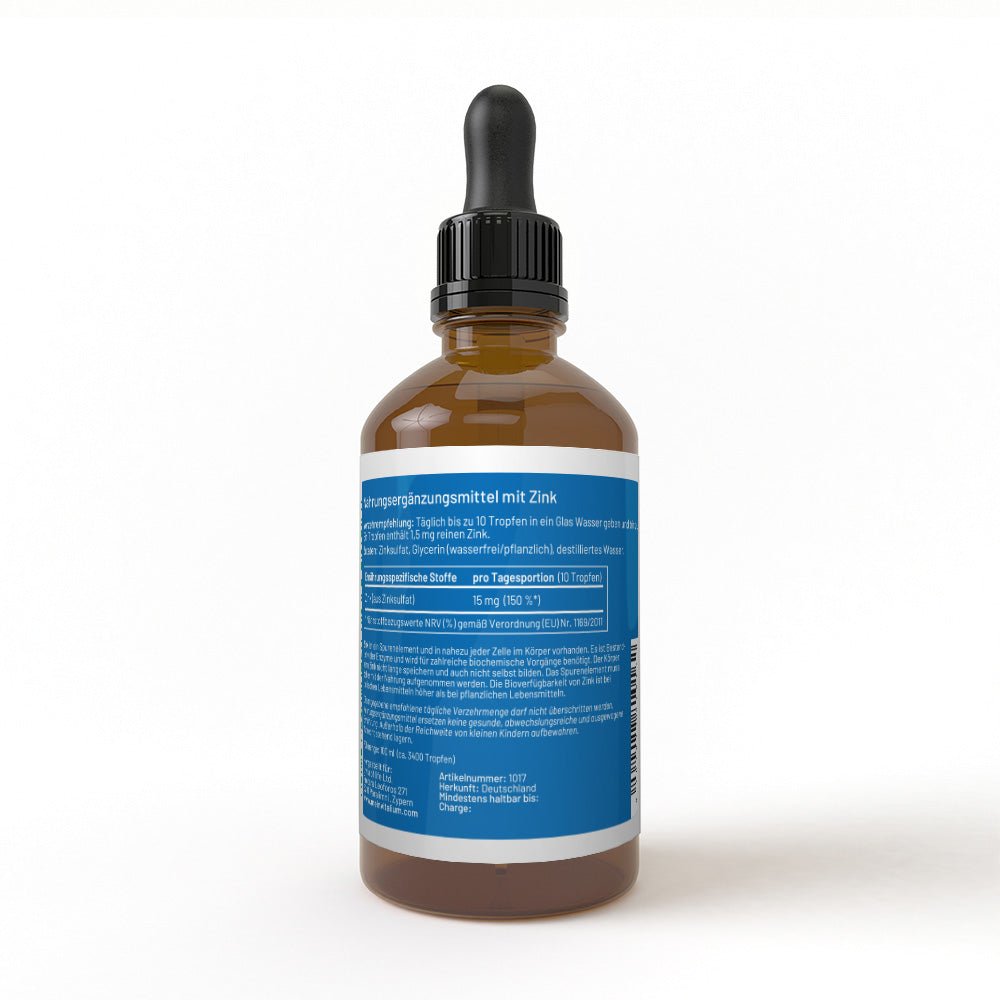
| Nährstoff | 1 drop | Daily serving (10 drops) | % NRV* per daily serving |
|---|---|---|---|
| Zinc (from zinc sulphate) | 1.5 mg15% NRV | 15 mg | 150 % |
* Nutrient Reference Values (NRV) (%) in accordance with Regulation (EU) No 1169/2011. The daily serving is up to ten drops. The table also shows the amount per drop.
Ingredients & product information
Name: Food supplement containing zinc
Net quantity: 100 ml (approx. 3,400 drops)
Ingredients: Zinc sulphate, glycerine (anhydrous/vegetable), distilled water
Recommended daily intake: Add up to 10 drops to a glass of water daily and drink. One drop contains 1.5 mg of zinc from zinc sulphate.
Warnings: Do not exceed the stated recommended daily dose. Food supplements should not be used as a substitute for a varied and balanced diet and a healthy lifestyle. Keep out of the reach of young children. Store in a cool, dry place.
Origin: Germany
Manufactured for: trivia of life Ltd., Protara Leoforos 271, 5291 Paralimni, Cyprus

Background
A few terms to help when reading labels.
What is zinc sulphate?
Zinc sulphate is a salt of zinc and one of the compounds authorised in the EU for use in food supplements. It dissolves well in water and is therefore suitable for a liquid formulation. The specification of 1.5 mg per drop refers to the zinc content, not to the compound.
Why glycerine?
Vegetable glycerine and distilled water form the solution. The formula does not contain any alcoholic ethanol. This means the drops contain just three ingredients.
What does zinc taste like?
Zinc salts have a slightly metallic and bitter taste. When diluted in a glass of water, the taste is significantly milder.
Zinc and copper
High levels of zinc over the long term can impair the absorption of copper. This is another reason why it is worth keeping an eye on the total amount from all sources.

Added value in everyday life
Chickpeas, tahini and pumpkin seeds are plant-based sources of zinc. As you’re soaking the chickpeas yourself, this can also help to reduce their phytate content.
Ingredients
Preparation
Good to know: This recipe idea is intended as inspiration; nutrient content varies depending on the ingredients.
Product & quality

Vegan
Contains no animal-derived ingredients; contains vegetable glycerine.
Ingredients
Zinc sulphate, glycerine and distilled water. Contains no ethanol.
Zinc per drop
Can be dosed drop by drop, up to ten drops a day.
Daily servings
Approx. 3,400 drops per bottle, based on ten drops a day.
Add up to ten drops to a glass of water each day, stir briefly and drink it all. You can choose any time of day.
It is intended to be taken diluted in a glass of water, as stated in the recommended daily intake. Undiluted, the solution tastes very intense.
One drop contains 1.5 mg of zinc. Ten drops amount to 15 mg, which is 150% of the nutrient reference value. The nutrient reference value for zinc is 10 mg, so one drop corresponds to 15%.
No. The recommended daily intake is up to ten drops. You can take fewer drops, for example if you already get plenty of zinc from your diet. You can use the drop calculator to see how much zinc your chosen number of drops provides.
A bottle contains 100 ml, which is approximately 3,400 drops or around 340 daily servings of ten drops each. Please note the best-before date on the bottle.
Hold the pipette vertically and squeeze the rubber bulb slowly so that the drops come out one at a time. Count the drops rather than using a full pipette.
Both are possible. Some people experience mild nausea when taking zinc on an empty stomach. In that case, taking it with or after a meal is the better option.
Zinc salts have a slightly metallic and bitter taste. When diluted in a glass of water, the taste is significantly milder.
Our multivitamin complex already contains 13 mg of zinc. Together with ten drops, this would amount to 28 mg per day, not including dietary intake. This exceeds the tolerable upper limit of 25 mg, which applies in the EU for the total daily intake for adults. You should therefore not combine the products without consulting a doctor.
Stick to the recommended daily intake and add up the total amount of zinc from all sources. High levels of zinc over the long term can impair the absorption of copper. If you wish to take zinc supplements for an extended period, it is best to discuss this with your doctor.
Zinc contributes to the normal function of the immune system. However, food supplements are not intended to prevent or treat diseases. If you have a cold with severe or long-lasting symptoms, seek medical advice.
Zinc may interfere with the absorption of certain antibiotics, such as tetracyclines and quinolones, as well as oral bisphosphonates used to treat osteoporosis. The required interval and sequence depend on the active ingredient. Follow the instructions in the package leaflet and ask your pharmacist or doctor for advice.
Zinc requirements are slightly higher during pregnancy and while breastfeeding. Please discuss with your doctor or midwife beforehand whether additional supplementation is advisable and, if so, in what quantity.
The product is intended for adults. Age-specific recommendations apply for children and adolescents. Keep the bottle out of the reach of young children.
Zinc sulphate is one of the zinc compounds authorised in the EU for use in food supplements. It dissolves well in water and is therefore suitable for a clear, liquid formulation.
Yes, the drops are vegan and contain no potable alcohol (ethanol). They consist of zinc sulphate, vegetable glycerine and distilled water.
Plant-based sources of zinc, such as whole grains and pulses, contain phytate, which reduces absorption. A high intake of phytate therefore increases the body’s requirement for zinc. Soaking, sprouting and sourdough can reduce the phytate content. Whether you need additional zinc depends on your overall diet. A doctor can determine this by checking blood test results, such as serum or plasma zinc levels.
Keep tightly closed, in a cool, dry place and out of the reach of young children. Do not wipe the pipette with your fingers after use and do not leave it uncovered.
From the German Nutrition Society on the reference values for nutrient intake and in the BfR proposed maximum levels.
👍👍👍
Gehört in jede gute Hausapotheke das Zeug. Lieferung in 2 Tagen mit DHL, bin ich zufrieden mit
Ein Stück Siziliens daheim, das erfreut mich bei jedem Kochen von neuem, danke.
Bisher kann ich nicht klagen. Habe es bei Mundschleimhaut angewandt und es hat nicht enttäuscht
Preis Leistung soweit top - Lösung hat die gewünschte gelbliche Farbe und den bekannten Geruch, Verpackugn sehr hochwertig, viel besser als alles von Amazon bisher!
Das Produkt kam schnell an und war sorgfältig verpackt.
Mir gefällt, dass hier auf einen bekannten Markenrohstoff gesetzt wird.
Hochwertiger Rohstoff und angenehme Kapselgröße.
Sehr aromatisch und schön verpackt.
ich trinke täglich ca. 1 Esslöffel davon oder gebe die Menge meinem Frühstück hinzu (ohne erhitzen!), aufgrund der vielen polyphenole enorm wertvoll für eine gesunde fettaufnahme
Die Dosierung passt für mich sehr gut in den Alltag.
Ich habe das erste mal bestellt bei euch, Lieferung kam zügig, die Kapseln haben genau die Dosierung die ich täglich benötige. 5000 IE D3 plus 200my K2. Die Kapseln reichen für 90 Tage, so muss ich nicht so oft bestellen. Zur Wirkung kann ich nicht viel sagen, da ich schon seit Jahren D3 nehme und seit dem auch nie mehr krank war. Die Kapseln sind einfach zu schlucken. Also alles gut.
Sehr schnelle Lieferung!
Fast and Furious
Ihr habt uns trotz Lieferschwierigkeiten sehr dabei geholfen das das Paket endlich angekommen ist. Da könnt ihr ja nichts dafür. Durch den ständigen Kontakt hat man sich verstanden gefühlt auch wenn man Wut hatte sein Paket nicht zu erhalten. Danke dafür.

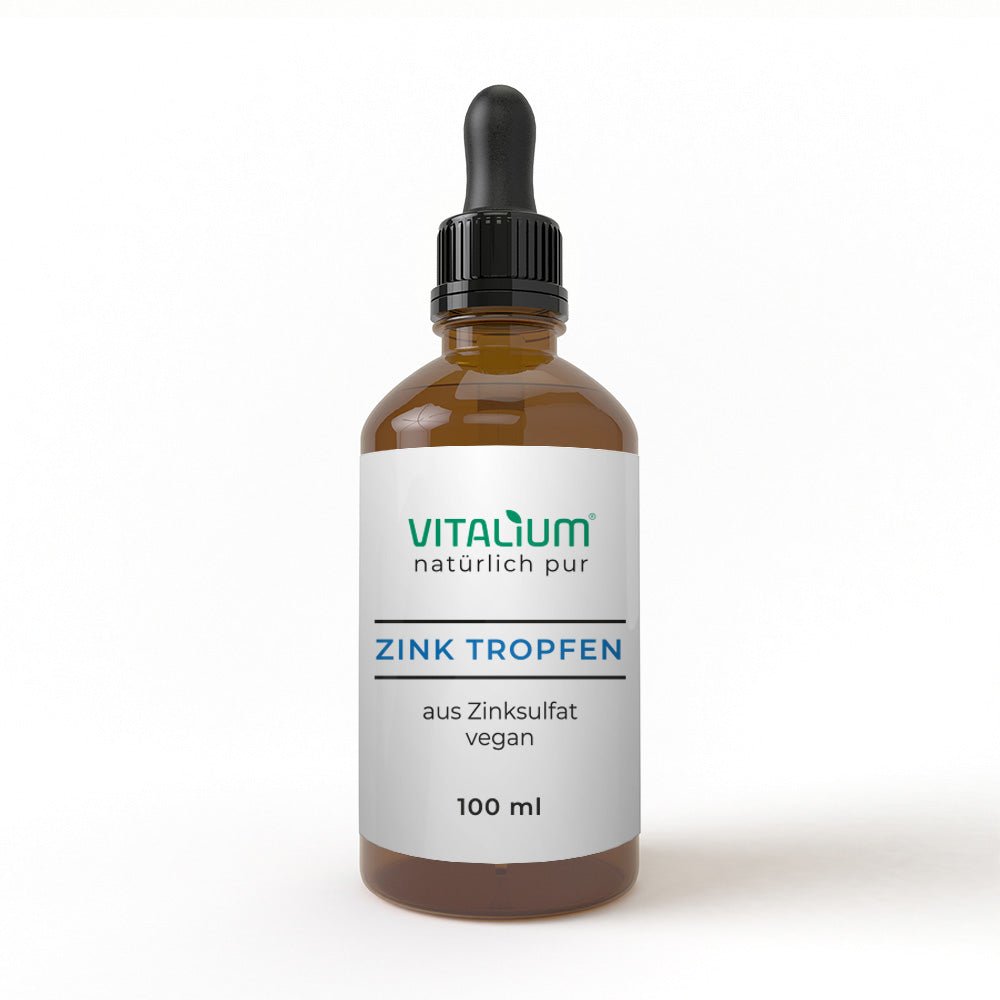
Zinc drops
100 ml zinc solution made from zinc sulphate, approx. 3,400 drops. Recommended daily intake: up to ten drops daily in a glass of water.
Always stocked up on time: save 5% with Subscribe & save
All prices include VAT, plus shipping.