
Prepare the tank
Empty the tank completely. Follow the instructions provided by the respective manufacturers for water filters, boilers and seals; remove filters beforehand if necessary.


Pay securely and easily with:


Your payment information is processed securely. We do not store credit card details nor have access to your credit card information.
How to use
Whether it’s a motorhome, caravan or boat: you can disinfect the tank and pipes with a shock disinfection; when filling the tank, you can disinfect the drinking water using a low dosage. According to the label, the 250 ml bottle is sufficient for a shock disinfection of a 125-litre tank.

20 ml
per 10 litres of water in the tank (shock disinfection)
Leave to act for 6 to 12 hours, then empty and rinse the tank and pipes.
For normal filling, use 0.67 ml per 10 litres; for a 100-litre tank, this amounts to 6.7 ml.
Prepare the tank
Empty the tank completely. Follow the instructions provided by the respective manufacturers for water filters, boilers and seals; remove filters beforehand if necessary.
Prepare the shock disinfection solution
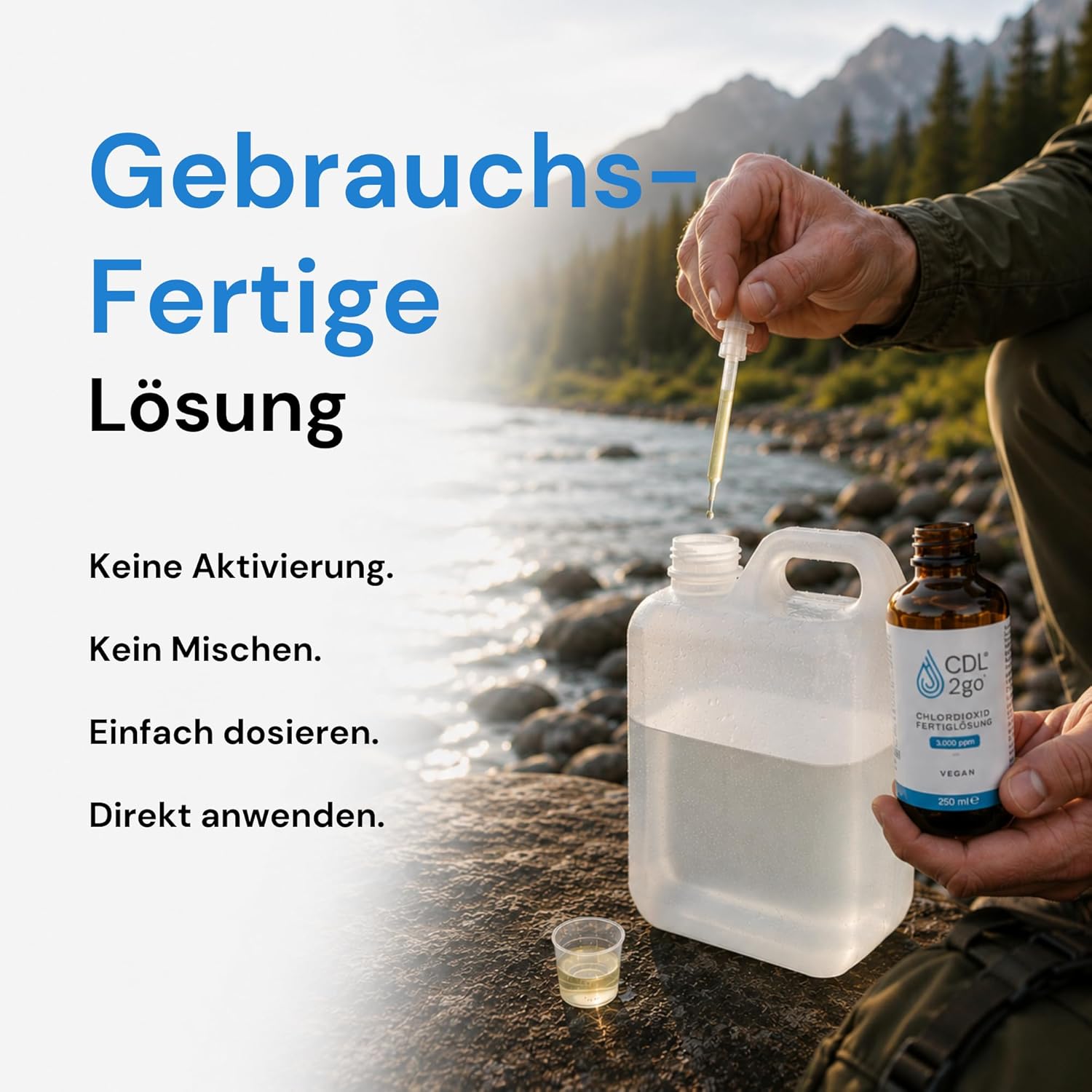
Fill the tank completely with tap water and add 20 ml of the solution per 10 litres of water. Open all taps one after the other until water flows from the tank, then close them again. Leave the solution to work for 6 to 12 hours.
Empty and rinse
Empty the tank and pipes completely and rinse thoroughly with fresh tap water. Water used for shock disinfection is not suitable for drinking.
Drinking water during filling
To disinfect the drinking water, add 0.67 ml per 10 litres of tap water while filling and leave it to work for 20 minutes, as per the manufacturer’s instructions. Do not add another dose until at least 24 hours have passed.
Use biocidal products with care. Always read the label and product information before use. Water from a shock disinfection is not suitable for drinking.
Dosage table
| Water in the tank | Shock disinfection | When filling |
|---|---|---|
| 50 litres | 100 ml | 3.4 ml |
| 75 litres | 150 ml | 5.0 ml |
| 100 litres | 200 ml | 6.7 ml |
| 125 litres | 250 mla whole bottle | 8.4 ml |
Calculated for a fully filled tank: shock disinfection at 20 ml per 10 litres with a contact time of 6 to 12 hours; when filling, 0.67 ml per 10 litres and 20 minutes. Values rounded. You’ll find your tank’s volume in the vehicle documents.

Good to know
Whether it’s a motorhome, a boat or a holiday home: a water tank needs looking after, even if the water looks clean.
Stagnant water, warm days
Water that sits in the tank and in the pipes heats up in summer. Germs can then settle on the tank walls, in hoses and filters, and form a biofilm. Contaminated water often looks clear and has no noticeable odour.
When a shock disinfection may be advisable
This depends on the usage, duration of inactivity and condition of the system. Typical occasions include the start of the season, the end of the winter break or long periods of inactivity. Also, follow the maintenance and hygiene instructions provided by the vehicle or tank manufacturer.
Considering the whole system
The solution should reach not only the tank but also the pipework. For filters, boilers and seals, follow the instructions provided by their respective manufacturers.
Areas of application
The product is notified to the Federal Office for Chemicals (BAuA) for product types (PT) 2, 3, 4 and 5. The 250 ml bottle is intended for larger volumes of water. For jerrycans and occasional dosing, there is CDL2go 100 ml.
Motorhomes and caravans
Shock disinfection of the fresh water tank, for example at the start of the season or after long periods of inactivity, and disinfection of the drinking water during filling.
Boats and yachts
Drinking water tanks on board, which are often left standing for long periods and heat up in the sun.
Holiday homes and storage
Water tanks and larger storage containers containing tap water, for example in a garden shed or for emergency preparedness.
Animal husbandry
Disinfection of surfaces and objects in areas where animals are kept (product type 3). Follow the instructions on the label when using the product.
Safety
Use biocidal products with care. Always read the label and product information before use. A safety data sheet is available on request via our contact form.
Do not ingest
This solution is not intended for oral consumption or for use on humans. It is intended for the disinfection of water, surfaces and objects as specified on the label. The authorities expressly warn against the ingestion of chlorine dioxide products.
Storage and children
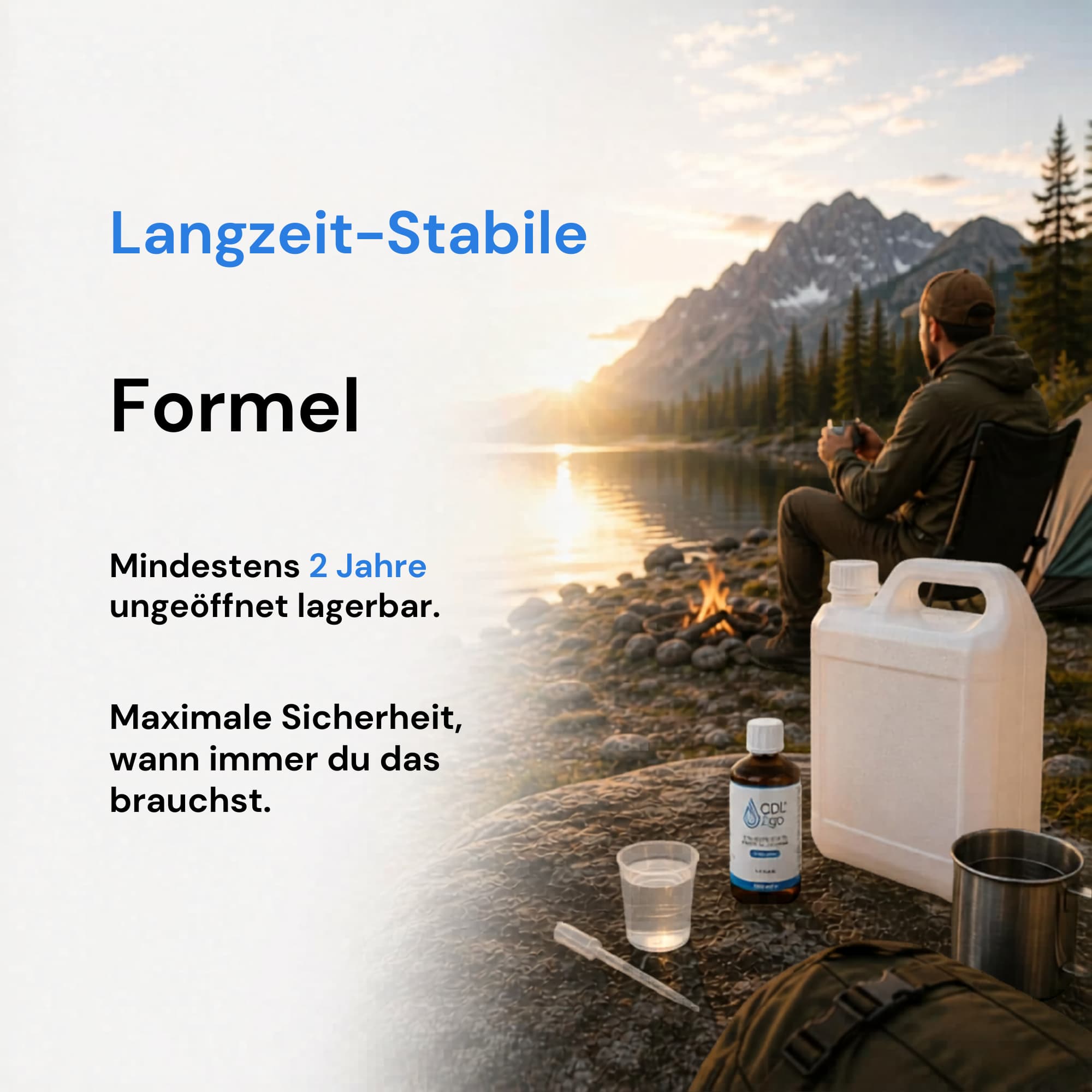
Store in a cool, dry place, protected from light, in an upright position and tightly sealed in the original labelled bottle; keep refrigerated after opening. Use by the date printed on the label. Keep out of the reach of children.
First opening
Place the bottle in the fridge for about an hour before opening it for the first time. Open it slowly. Do not inhale any escaping gas.
First aid
If swallowed, rinse the mouth immediately; do not induce vomiting; contact the poison control centre or seek medical advice straight away, showing the label. After skin contact, wash with soap and water; after eye contact, rinse gently with water for a few minutes. Berlin Poison Control Centre: 030 19240; in the event of severe symptoms, call the emergency services on 112.
Transparent labelling
| Information | Value |
|---|---|
| Active ingredient | Chlorine dioxide (ClO₂)2,990 ppm, approx. 0.3% |
| CAS No. | 10049-04-4 |
| EC No. | 233-162-8 |
| BAuA Reg. No. | N-118093 |
| UFI | 1300-P0FW-200W-G7KU |
| Product types | PT 2, 3, 4, 5 |
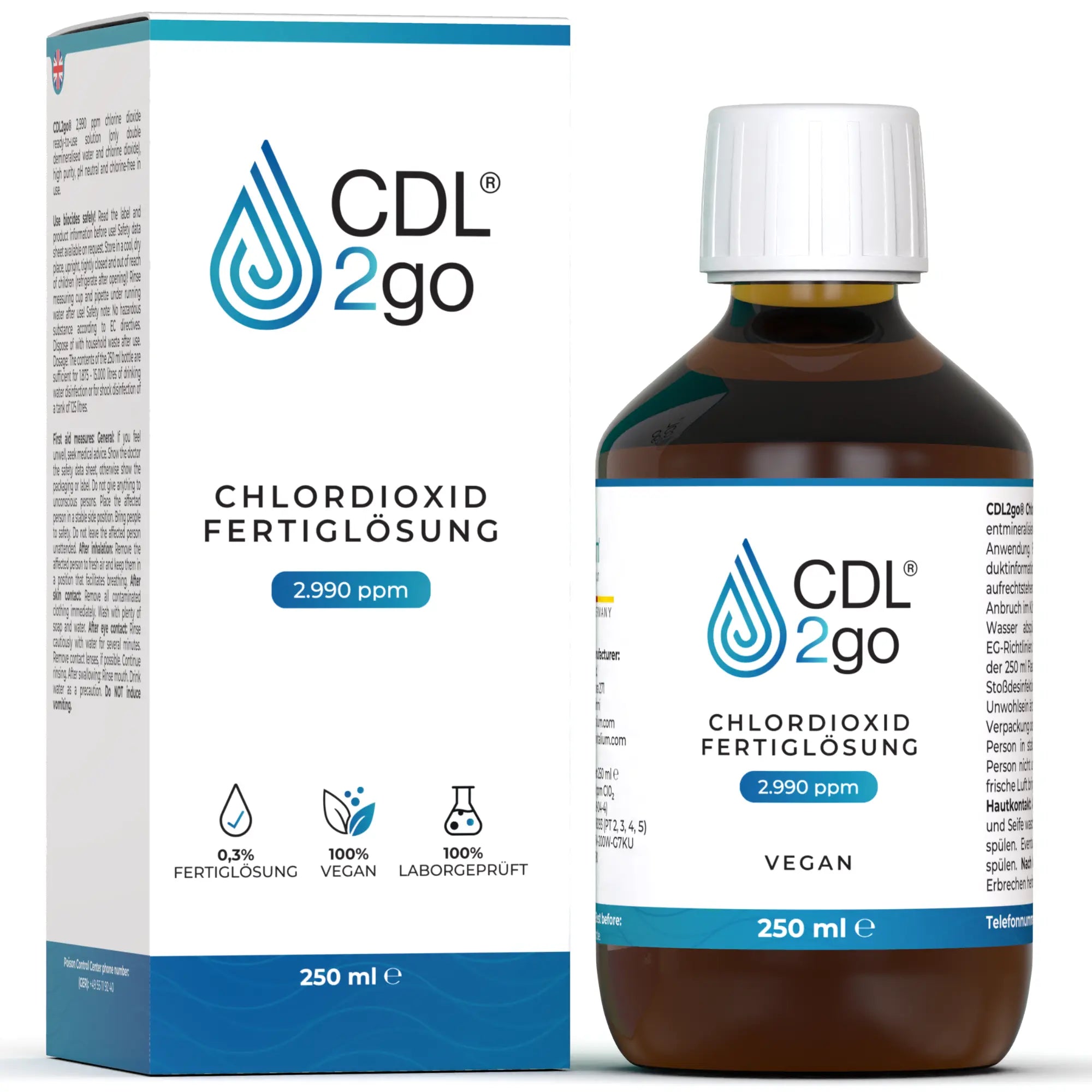
| Contents | 250 mlAmber glass bottle |
Notified to the BAuA under N-118093. The notification is not an official authorisation and not an efficacy test.
Product details
Name: CDL2go ready-to-use chlorine dioxide solution, 2,990 ppm
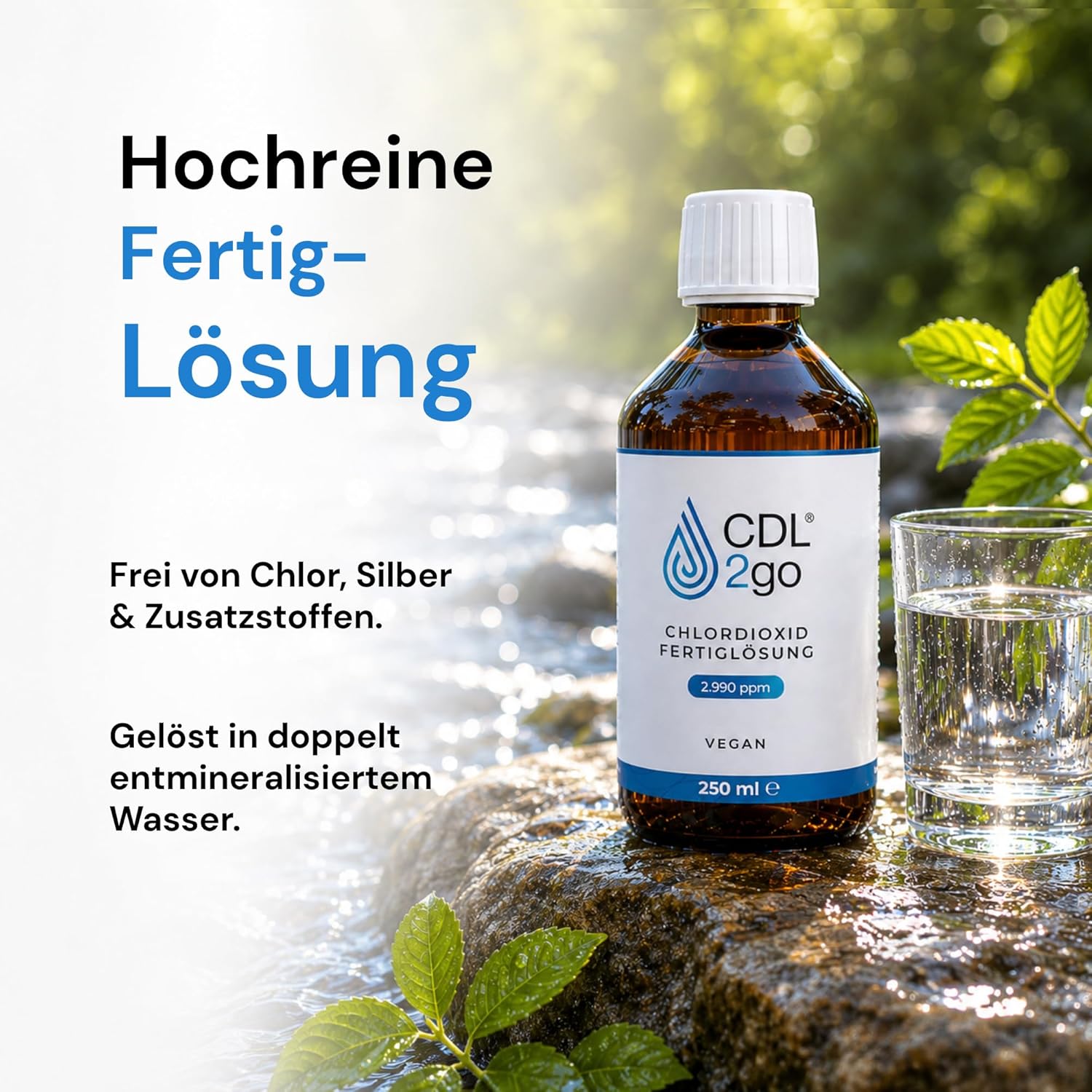
Composition: Chlorine dioxide, dissolved in double-demineralised water
Yield: At 0.67 ml per 10 litres, the 250 ml bottle is sufficient for approximately 3,700 litres of drinking water, or for shock disinfection of a 125-litre tank. The label states 1,875–15,000 litres; this range results from different dosages.
Drinking water dosage (Germany): 0.67 ml (approximately 13 drops) per 10 litres of tap water, 20-minute contact time, repeat dosage no sooner than 24 hours later.
Shock disinfection: 20 ml per 10 litres of water in a fully filled tank, leave to act for 6 to 12 hours, then empty and rinse.
Warnings: Use biocidal products with care. Always read the label and product information before use. Not for ingestion and not for use on humans. Not a medicinal product, not a foodstuff. Safety data sheet available on request.
Storage: Store in a cool, dry place, protected from light, in an upright position, tightly sealed and out of the reach of children. Chill for about an hour before opening for the first time; keep refrigerated after opening. Use by the date printed on the packaging. Rinse the measuring cup and pipette under running water after use.
Disposal: In accordance with the label and local regulations.
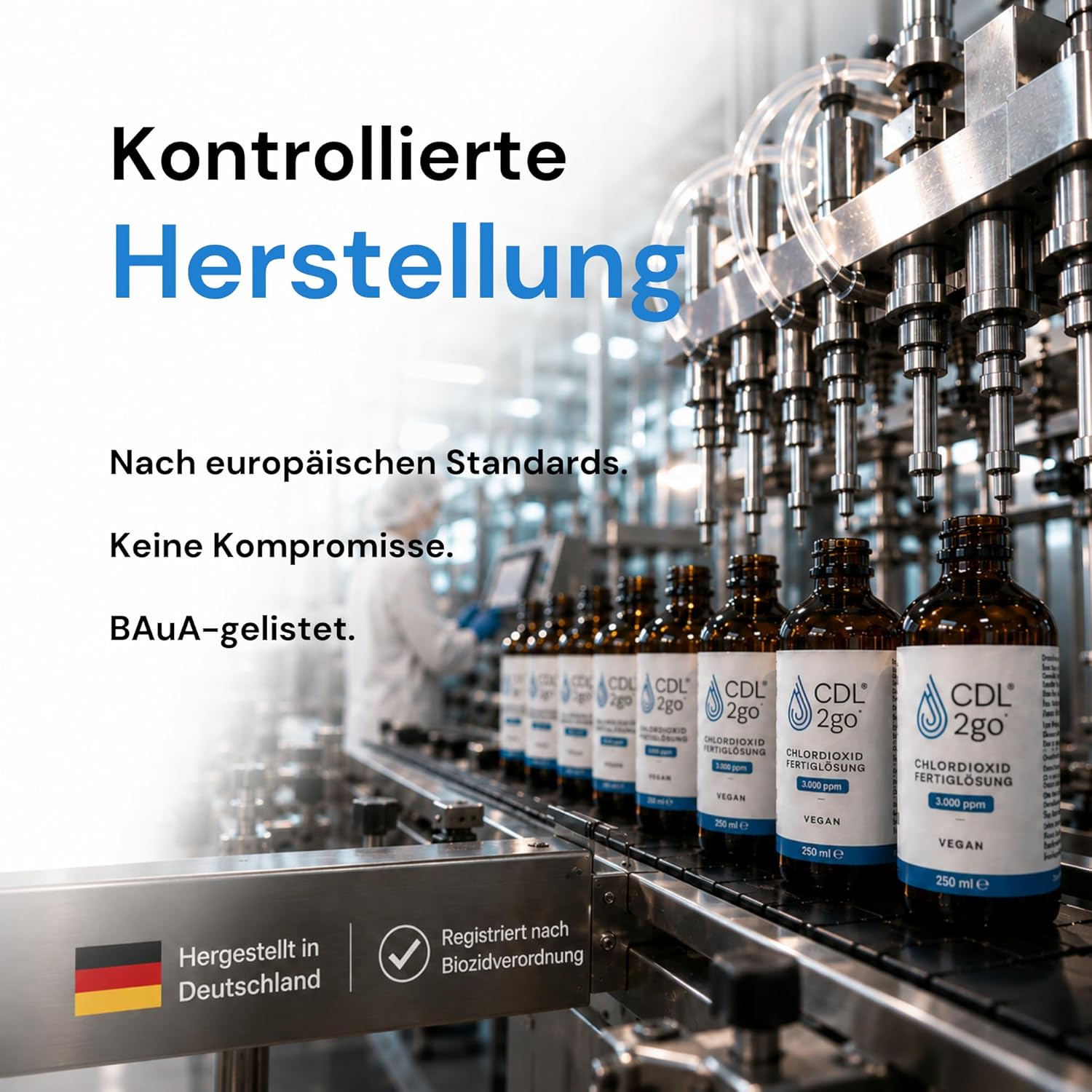
Made in: Germany
Manufacturer: trivia of life Ltd., Protara Leoforos 271, 5291 Paralimni, Cyprus
Product & quality
Notified
Notified to the BAuA under N-118093. No authorisation.
Listed supplier
Our active ingredient supplier is listed on ECHA’s Article 95 list for chlorine dioxide.
Manufacture
Manufactured in Germany.
Amber glass bottle
Protected from light, with pipette and measuring cup for dosing.
Empty the tank, fill it completely with tap water and add 20 ml of the solution per 10 litres of water. Open all taps one after the other until water flows from the tank, then close them again and leave the solution to work for 6 to 12 hours. Then completely empty the tank and pipes and rinse thoroughly with fresh tap water.
For shock disinfection, use 20 ml per 10 litres of water in a fully filled tank; for a 100-litre tank, this means 200 ml. According to the label, the 250 ml bottle is sufficient for a 125-litre tank. The figures for 50 to 125 litres are given in the dosage table.
This depends on the usage, duration of inactivity and condition of the system. Typical occasions include the start of the season, the end of the winter break or long periods of inactivity. Also, follow the maintenance and hygiene instructions provided by the vehicle or tank manufacturer.
Yes. During the shock disinfection, open all taps one after the other until water flows from the tank, then close them again. This ensures the solution reaches the pipes as well.
No. Water from the shock disinfection is not drinking water. After 6 to 12 hours, completely empty the tank and pipes and rinse them thoroughly with fresh tap water. Only then should you fill the tank with drinking water.
To disinfect drinking water, use 0.67 ml per 10 litres of tap water; for a 100-litre tank, this amounts to 6.7 ml. In numerical terms, this equates to an addition of approximately 0.2 mg of chlorine dioxide per litre. According to the manufacturer’s instructions, allow it to take effect for 20 minutes; do not add another dose until at least 24 hours have passed.
At the dosage described here of 0.67 ml per 10 litres, the 250 ml bottle is sufficient for around 3,700 litres; for a 100-litre tank, this equates to around 37 fillings. After a shock disinfection, correspondingly less will remain. The label states 1,875–15,000 litres; this range results from different dosages.
For filters, boilers, seals and pipes, follow the instructions provided by their respective manufacturers. Remove filters before carrying out shock disinfection if necessary.
Yes. The same procedure applies to drinking water tanks on board as in a motorhome: shock disinfection using 20 ml per 10 litres of water in the tank; for disinfecting the drinking water, use 0.67 ml per 10 litres when filling.
Upright, tightly sealed and in a cool place; once opened, keep it in the fridge. Do not leave it in a hot vehicle in summer, as heat causes chlorine dioxide to escape as a gas. Use by the date printed on the bottle.
For jerrycans and occasional dosing, CDL2go 100 ml is often sufficient. The concentration and composition are the same; you’ll also find a dosing chart there for 5 to 25 litres.
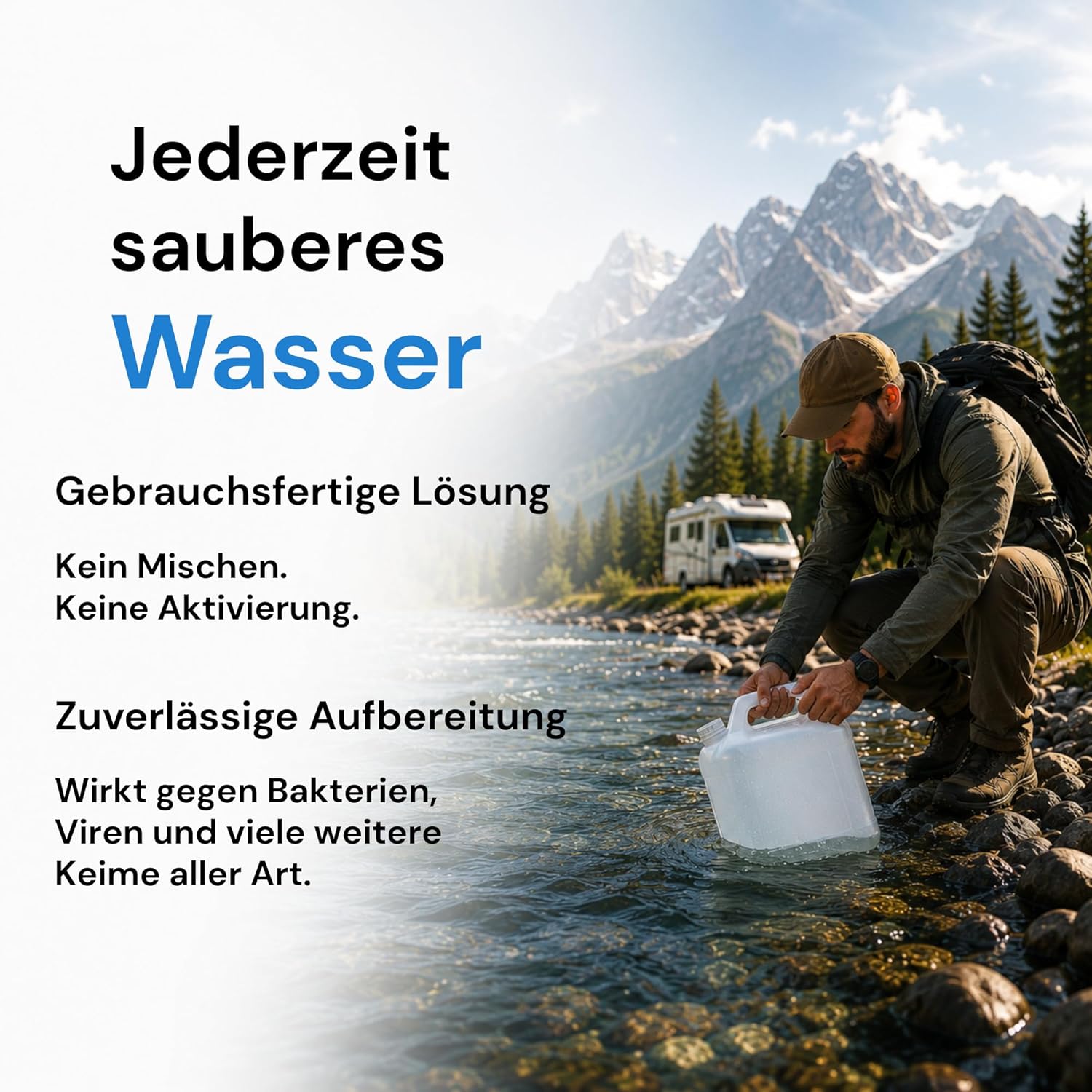
No. The chlorine dioxide is already fully dissolved; there is no need to mix it with a second component. To use it, dilute the solution with water as per the instructions.
No. The solution is not intended for ingestion or for use on humans. It is neither a medicine nor a foodstuff.
Rinse your mouth immediately, do not induce vomiting, and contact the poison control centre or seek medical advice straight away, showing them the label. Berlin Poison Control Centre: 030 19240; in the event of severe symptoms, call the emergency services on 112.
CDL2go is notified to the BAuA under N-118093. The notification is not an official authorisation and not an efficacy test. Our active substance supplier is listed on ECHA’s Article 95 list for chlorine dioxide and the relevant product types. This listing is not a quality seal for the end product.
Yes, on request via our contact form. You can already find key details such as the BAuA reg. no. N-118093, UFI and CAS no. here on this page under Product data.

CDL2go 250 ml
Shock disinfection for tanks up to 125 litres; thereafter, 0.67 ml per 10 litres while filling. Use biocidal products with care. Always read the label and product information before use.
All prices include VAT, plus shipping.